Click an author to filter the list of related assets below.
Abstract:
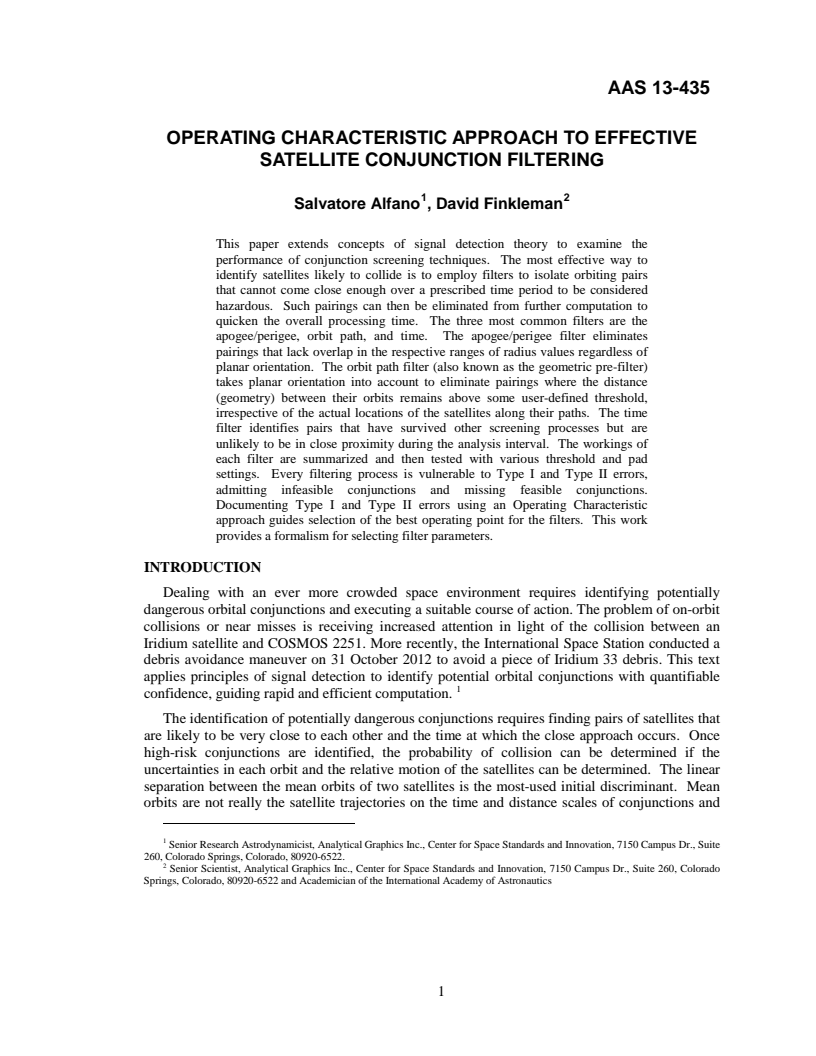
This paper extends concepts of signal detection theory to examine the performance of conjunction screening techniques. The most effective way to identify satellites likely to collide is to employ filters to isolate orbiting pairs that cannot come close enough over a prescribed time period to be considered hazardous. Such pairings can then be eliminated from further computation to quicken the overall processing time. The three most common filters are the apogee/perigee, orbit path, and time. The apogee/perigee filter eliminates pairings that lack overlap in the respective ranges of radius values regardless of planar orientation. The orbit path filter (also known as the geometric pre-filter) takes planar orientation into account to eliminate pairings where the distance (geometry) between their orbits remains above some user-defined threshold, irrespective of the actual locations of the satellites along their paths. The time filter identifies pairs that have survived other screening processes but are unlikely to be in close proximity during the analysis interval. The workings of each filter are summarized and then tested with various threshold and pad settings. Every filtering process is vulnerable to Type I and Type II errors, admitting infeasible conjunctions and missing feasible conjunctions. Documenting Type I and Type II errors using an Operating Characteristic approach guides selection of the best operating point for the filters. This work provides a formalism for selecting filter parameters.
Citation:
"Operating Characteristic Approach To Effective Satellite Conjunction Filtering," S. Alfano and D. Finkleman, Paper No. AAS 13-435, AAS/AIAA Space Flight Mechanics Meeting, Kauai, Hawaii, February 10 – 14, 2013.
Papers with related authors:
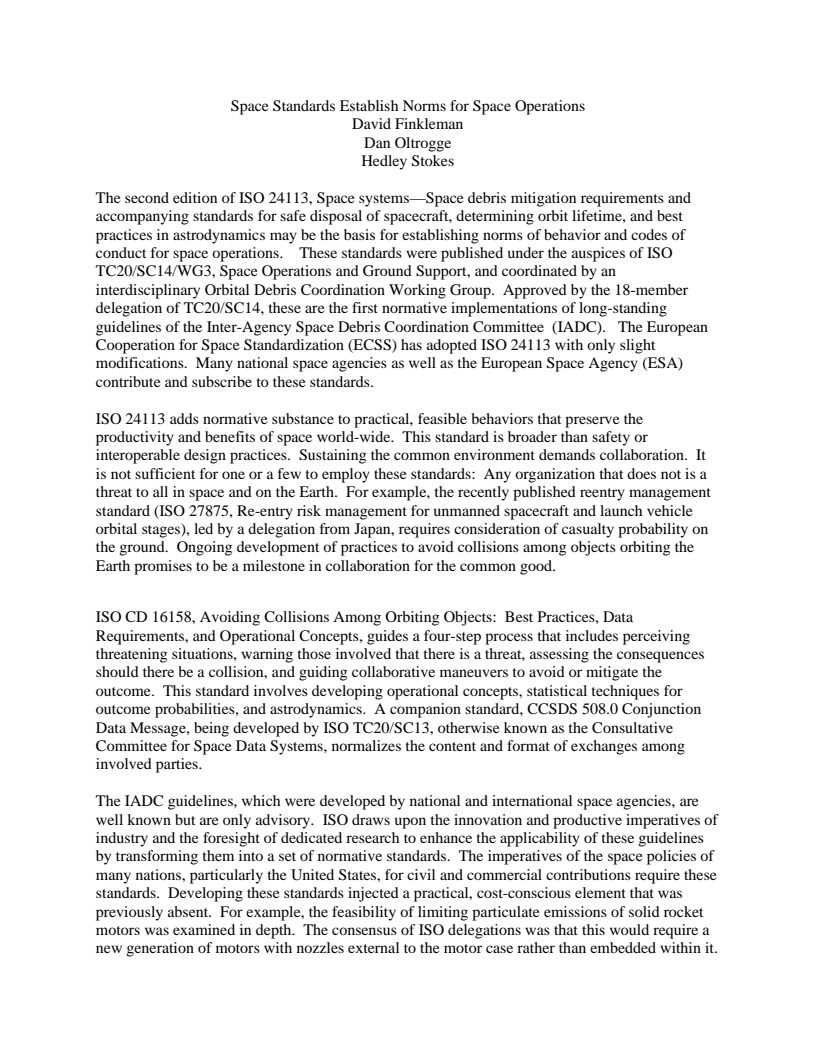
Space Standards Establish Norms for Space Operations