

INTRODUCTION
A Planet Wrapped in Motion
Every minute of every day, tens of thousands of objects orbit Earth. Some are operational satellites delivering GPS signals, weather data, broadband internet, and national security capabilities. Far more are space debris — spent rocket bodies, defunct spacecraft, and fragments from past collisions.
0 +
trackable objects in the catalog todayKnowing where all those objects are at any given moment isn't a simple matter. Space is a highly dynamic environment in which a multitude of forces push, pull, and cajole objects as they make their rounds. And many satellites can move themselves — in orbit this is called maneuvering — using thrusters.
0
miles per hour — typical orbital velocity in low Earth orbitThis presents a big problem: you can't assume things will keep orbiting exactly as they are. The only solution is to continuously monitor the objects in Earth's orbit. And this is where space situational awareness (SSA) comes in. At its most elemental, SSA is the practice of tracking objects in Earth orbit, understanding their motion, and predicting their near-future positions.
0 /7
continuous monitoring required to keep solutions currentTHE STAKES
How Space is Essential to Modern Life
Most people know that there are many satellites orbiting Earth, relaying information and images. But fewer realize how completely that our daily life — and national defense — now depends on them. A degraded space environment is not an abstract concern; it is a direct threat to economic stability and national defense.
$0.0T+
0+
0%
THE CROWDING PROBLEM
The Risks of the Growing Use of Space
Space itself is stupendously vast — but the useful bands of Earth orbit are limited, and the number of objects in each has ballooned. In 1960, fewer than 50 objects were tracked in orbit. Today, the catalog exceeds 47,000 — and dangerous-but-untrackable debris is estimated in the millions.
What’s more, the rate of proliferation of objects in Earth orbit is sharply increasing. This makes the problem of knowing where everything is and where it’s all going is becoming more important and more difficult at the same time.
Tracked objects in Earth orbit, 1957 → today
Two factors that cause sudden spikes in orbit population: large commercial constellations deploying tens of thousands of satellites in low Earth orbit, and debris-generating events — ASAT tests, in-orbit collisions, and the gradual breakup of aging hardware.
The Kessler syndrome
The most concerning long-term scenario: collisions generate enough debris to trigger further collisions in a cascade that could render entire orbital regimes unusable for generations. Avoiding the Kessler syndrome depends on predicting close approaches (or, conjunctions) accurately and swiftly enough that the warnings can be heeded.
THE CONTESTED DOMAIN
War in Space
Space, once a sanctuary by treaty and necessity, has become an actively contested domain. Adversary nations have demonstrated a growing range of counterspace capabilities, terrestrial and space-based. Military leaders around the world generally agree that, in the event of a new major-powers conflict, space will inevitably become part of the battlefield.
There are many reasons for this assumption, the most obvious of which are the strategic advantage of controlling who has access to space and the economic and infrastructure harm you can inflict by cutting an adversary off from space. But another significant reason for the appeal of warfighting in space is the broad spectrum of threats you can deploy — from limited, temporary harm to total devastation.
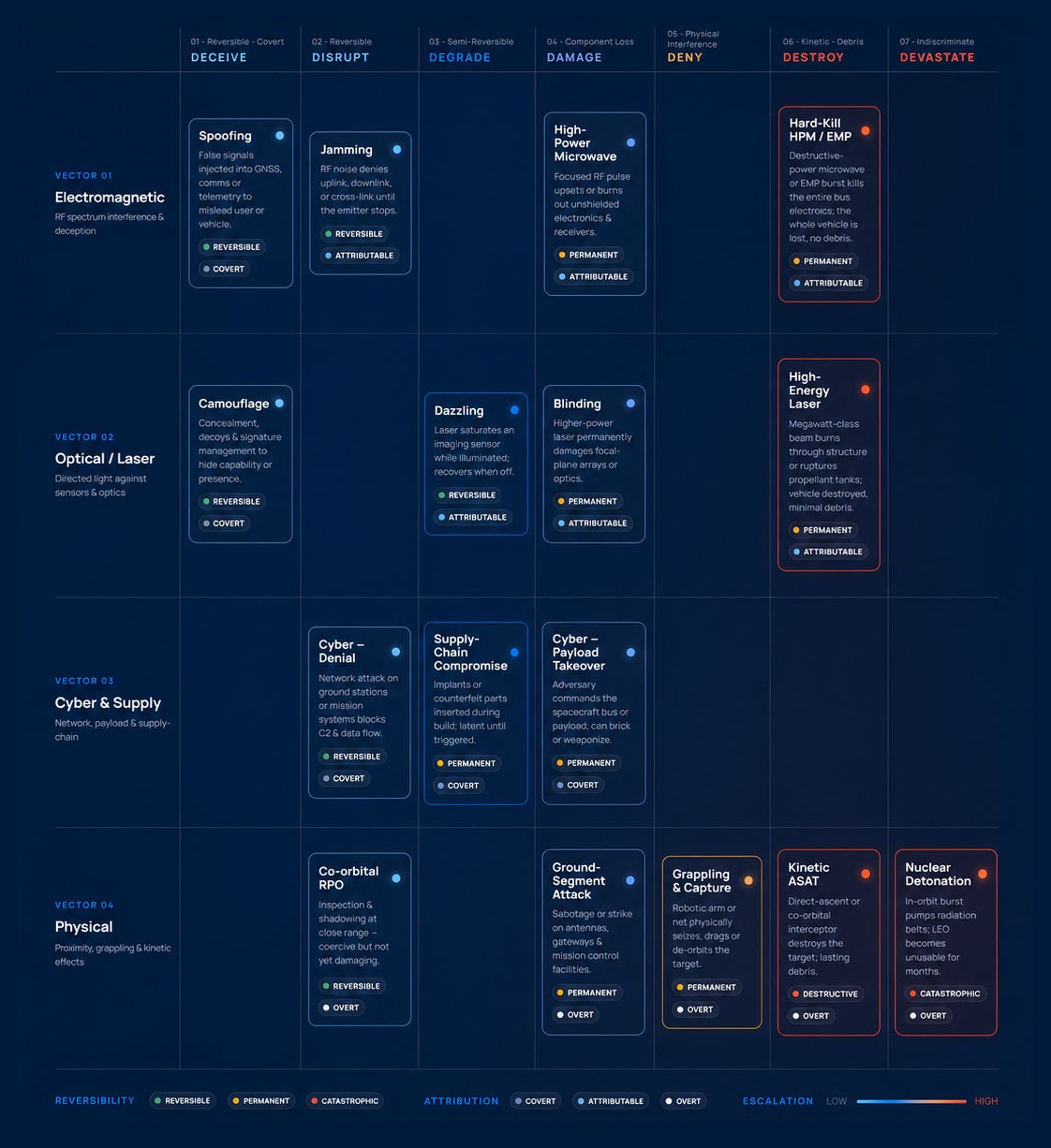
Counterspace Threat Spectrum
Fourteen categories of counterspace activity, arranged by escalation. Reading left → right, threats move from reversible deception with low attribution toward kinetic and indiscriminate effects with global, long-duration consequences. Rows group threats by primary vector; a single vector such as cyber can span multiple tiers depending on payload.
Spoofing
False signals injected into GNSS, comms or telemetry to mislead user or vehicle.
Jamming
RF noise denies uplink, downlink, or cross-link until the emitter stops.
High-Power Microwave
Focused RF pulse upsets or burns out unshielded electronics & receivers.
Hard-Kill HPM / EMP
Destructive-power microwave or EMP burst kills the entire bus avionics; the whole vehicle is lost, no debris.
Camouflage
Concealment, decoys & signature management to hide capability or presence.
Dazzling
Laser saturates an imaging sensor while illuminated; recovers when off.
Blinding
Higher-power laser permanently damages focal-plane arrays or optics.
High-Energy Laser
Megawatt-class beam burns through structure or ruptures propellant tanks; vehicle destroyed, minimal debris.
Cyber — Denial
Network attack on ground stations or mission systems blocks C2 & data flow.
Supply-Chain Compromise
Implants or counterfeit parts inserted during build; latent until triggered.
Cyber — Payload Takeover
Adversary commands the spacecraft bus or payload; can brick or weaponize.
Co-orbital RPO
Inspection & shadowing at close range — coercive but not yet damaging.
Ground-Segment Attack
Sabotage or strike on antennas, gateways & mission control facilities.
Grappling & Capture
Robotic arm or net physically seizes, drags or de-orbits the target.
Kinetic ASAT
Direct-ascent or co-orbital interceptor destroys the target; lasting debris.
Nuclear Detonation
In-orbit burst pumps radiation belts; LEO becomes unusable for months.
Counterspace Threat Spectrum
Fourteen categories of counterspace activity, arranged by escalation. Reading left → right, threats move from reversible deception with low attribution toward kinetic and indiscriminate effects with global, long-duration consequences. Rows group threats by primary vector; a single vector such as cyber can span multiple tiers depending on payload.
AWARENESS
Protecting the Space Domain
As you can probably see by now, we face a problem that won’t solve itself. Space is going to become more essential and more integrated to modern life and modern war. It will become more crowded. And as a result, the means and incentives to contest space will only increase.
Which brings us back to space situational awareness, or SSA. Without this essential knowledge, nothing is really safe. After all, you can’t avoid potential collisions that you can’t predict, and you can’t avoid attackers that you can’t see.
There are several terms in common use — presented in the cards in this section — that describe distinct aspects of space situational awareness, from how the analysis is applied to how it should be controlled or shared. This should give you a better sense of the breadth and complexity of the problem.
SSA
Space Situational Awareness
The foundational concept: knowing where objects are and where they are going. SSA is the perception layer — the ability to see and predict what is happening in orbit.
SST
Space Surveillance and Tracking
The sensing and cataloging function: networked sensors plus processing that detect, track, and maintain orbital data on human-made objects.
In European usage, this often refers specifically to EU SST, the EU Space Programme component delivering collision avoidance, reentry, and fragmentation analysis services.
THE PROCESS
How Space Situational Awareness Works
Space situational awareness is the result of a three-step process in which sensor data — from observations of objects in orbit — are turned into actionable insights about mission assurance, collision risk, satellite maneuvering, and more.
Observe
Sensors collect observations: Ground-based radars, optical telescopes, passive RF sensors (that listen for emissions), and a growing population of space-based sensors comprise the collection methods. Together they generate raw measurements — range, angles, signals, images — of objects in Earth orbit.
Each sensor type delivers a different kind of precision, so collecting data from multiple sensors and fusing that data is an important way to achieve high accuracy.
Process
Observations become information: SSA software associates each measurement with a known object or, if it finds no match, flags it as an uncorrelated track, or UCT.
Next, it performs orbit determination, or estimation theory — applying gravity, drag, solar radiation pressure — to compute updated trajectories for all the objects observed.
Depending on the software, additional workflows will examine uncorrelated measurements to see if they're known objects that maneuvered to a new orbit, or if they possibly represent a new object entirely.
Analyze
With updated orbit solutions, operators can obtain answers to the questions they care about: Is my satellite at risk of collision? Did an adversary's satellite just maneuver? Is my satellite in the proper orbit for its mission?
Analysis turns data into decisions, but that data needs to be accurate and timely to be reliable.
This is where the technology underlying an SSA system is vital. The power of the algorithms used to predict orbits and detect maneuvering determines how accurately a system can track objects, while the scaling of those computations determines how quickly that tracking can be updated.
OVERCOMING OBSTACLES
Technical Challenges of SSA
Describing the SSA process is straightforward. Doing it well — at scale, at operationally relevant speed — is genuinely hard. Several technical challenges define the field today.
Sensor coverage and tasking
No single sensor network can produce the best data for accurate orbit solutions across all orbit regimes. Instead, coverage of the sky and acuity of detection varies considerably. As a result, there's no easy, one-size-fits-all sensor solution.