Abstract:
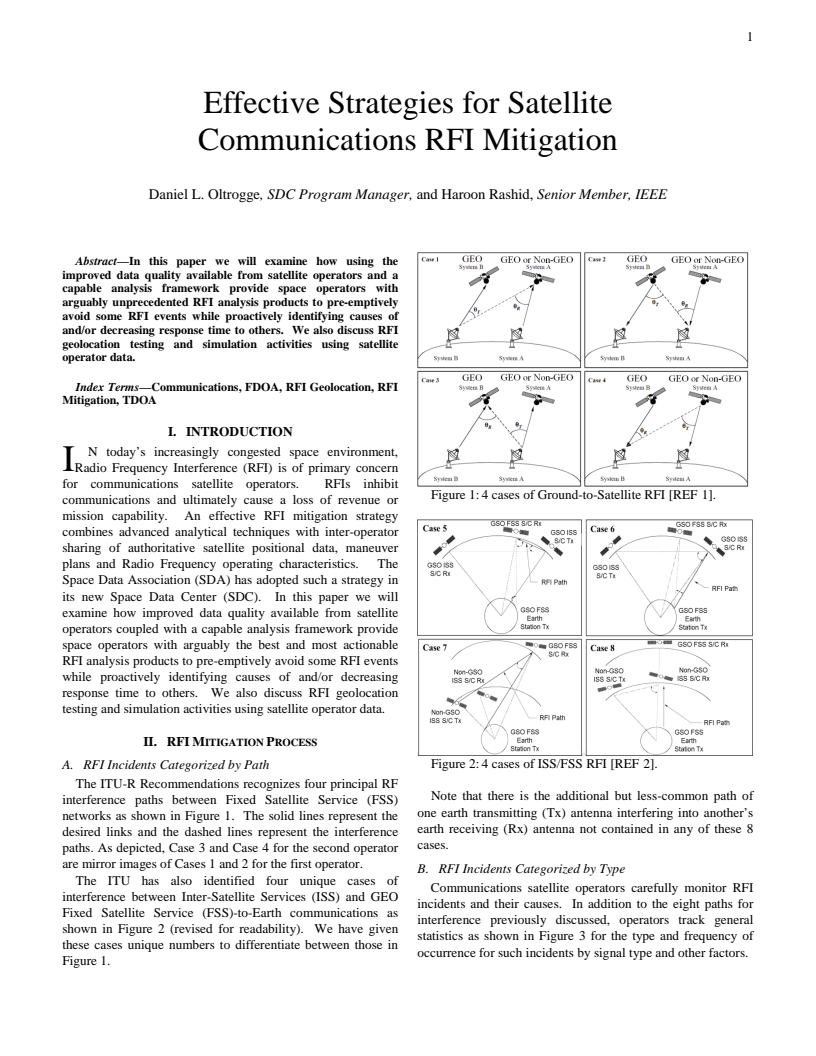
Radio frequency interference (RFI) remains a significant operational challenge for satellite operators, particularly in the geostationary orbit regime where adjacent satellite interference is prevalent. This work examines effective strategies for RFI mitigation that combine authoritative satellite operator data with an integrated analysis framework to enable timely, actionable responses. Emphasis is placed on cross-organizational data fusion, leveraging shared ephemerides, maneuver data, radio frequency parameters, and points of contact through the Space Data Association’s Space Data Center. The study evaluates reactive mitigation techniques such as carrier identification and TDOA/FDOA-based geolocation, as well as preemptive approaches including fly-by analysis, precomputed geolocation solution sets, and antenna pointing optimization. Case studies demonstrate that incorporating high-quality operator data can improve geolocation accuracy by up to an order of magnitude compared to public data sources. The analysis further identifies key contributors to geolocation degradation, including ephemeris uncertainty, satellite geometry, and measurement resolution. The results indicate that holistic data sharing and normalization significantly reduce RFI resolution timelines and improve operational resilience for satellite communications.
Keywords:
Click a keyword to filter the list of related assets below.
Oltrogge, D.L., “Effective Strategies for RFI Mitigation,” Satellite Interference Reduction Group, Dubai, 18 Nov 2012, accessible at https://comspoc.com/Resources/Content/Private/C-20220424T061312/Presentation/20121118_Effective_RFI_Mitigation_Oltrogge_iRG_Dubai_small.pdf.