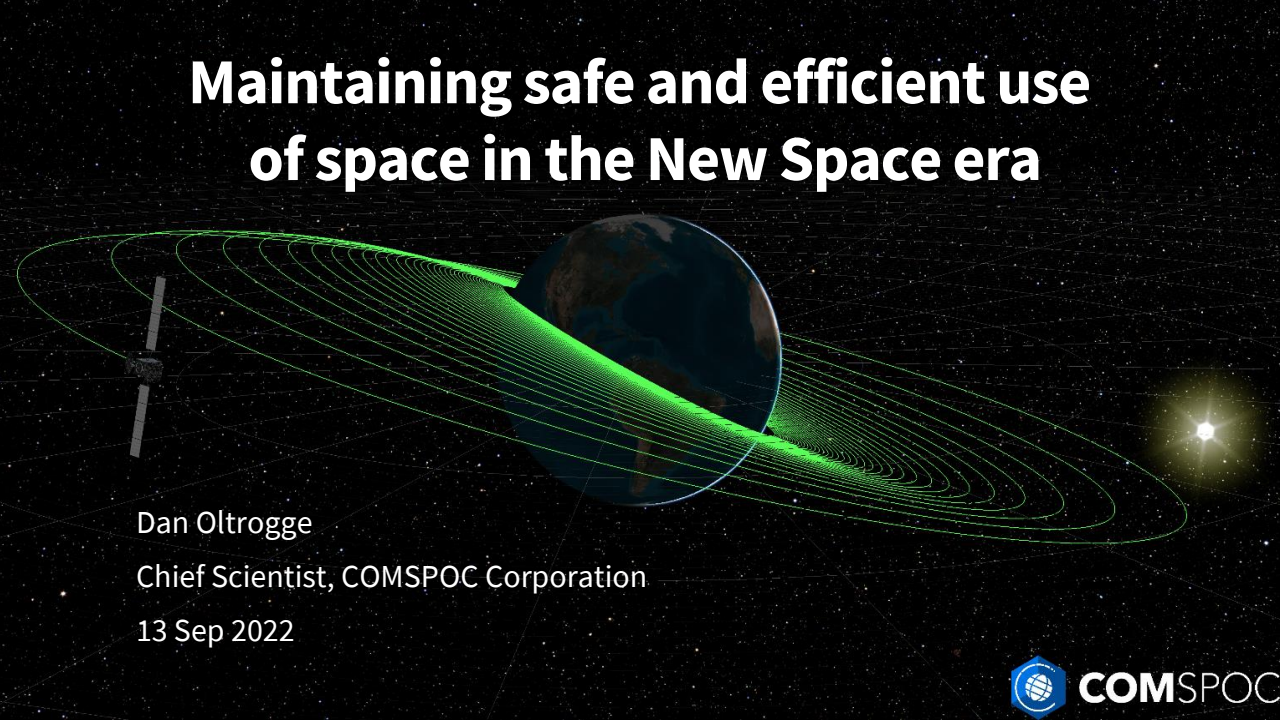
Maintaining safe and efficient use of space in the New Space era
Id: 322
Type: Presentation
Published: 09/13/2022
Event: International Space Radio Monitoring Meeting (ISRMM)
Authors:
Click an author to filter the list of related assets below.Abstract:
This work examines how the rapid growth of space activities in the New Space era has fundamentally altered the operational risk landscape in Earth orbit. Drawing on empirical data from satellite licensing applications, launch statistics, and conjunction analyses, the study characterizes dramatic increases in active spacecraft populations, close-approach rates, and collision risk, particularly in Low Earth Orbit. Volumetric encounter-rate methods and comparative assessments of major fragmentation events are used to illustrate how large constellations, antisatellite debris, and lethal non-trackable fragments drive sustained operational burden on satellite operators. The analysis highlights the emergence of recurrent conjunction “squalls,” which significantly amplify warning volumes and maneuver demands. A layered framework is presented linking Space Situational Awareness, Space Traffic Coordination, and Space Traffic Management with international standards, national regulation, and commercial best practices. The role of data sharing, normalization, and multi-source data fusion is emphasized as essential for decision-quality flight safety. The study concludes that maintaining safe and efficient use of space requires a collaborative governance approach, widespread adoption of international standards, and proactive coordination among operators, regulators, and SSA providers to ensure long-term orbital sustainability.
Keywords:
Click a keyword to filter the list of related assets below.Citation:
Oltrogge, D.L., “Maintaining safe and efficient use of space in the New Space era,” International Space Radio Monitoring Meeting, Paris France, 13 Sep 2022.
Papers with related authors:
Using Spacebook and Cesium to Promote and Enhance Flight Safety
Read MoreActionability and Persistence Of Conjunction Data
Read MoreActionability and Persistence of Conjunction Data
Read MorePractical issues with using a full gravity field
Read MoreSpace Traffic Coordination Framework for Success
Read MoreThe TraCSS Consolidated Pathfinder: Leveraging Commercial Capability in LEO
Read MoreDeep operator and SSA collaboration for space sustainability
Read MoreSynthetic Covariance Production Using a New Digital Approach
Read MoreInternational standards development activities supporting UN COPUOS LTS guidelines
Read More2023 Updated Space Safety Coalition Best Practices for the Sustainability of Space Operations
Read MoreProtecting the Operational Environment for SmallSats in the presence of Space Debris and ASAT Testing
Read MoreSustainable Coexistence in Space: How CubeSats and Small Satellites Fit in our Current Space Governance Framework
Read MoreActionability and Persistence of Conjunction Data
Read MoreDEEP OPERATOR AND SSA COLLABORATION FOR SPACE SUSTAINABILITY
Read MoreAwareness-raising and capacity building related to implementation of LTS Guidelines, §II.B: Safety of Space Operations
Read MoreAchieving Space Sustainability through Intense Operator and SSA Collaboration
Read MoreSpacecraft Safety Made Stronger: Taking the Space Data Center to the Next Level
Read MoreStandards considerations for a space domain where humans will travel to, live in, and work.
Read MoreComparison of predicted and observed spacecraft encounters from Russian ASAT test
Read MoreAssessing passive radar for LEO SSA
Read MoreSpace Situational Awareness from the Commercial Perspective: COMSPOC, SDA, and SSC
Read MoreIdentifying Critical LEO Kinetic Space Safety Activities
Read MoreSpace Traffic Management: On the topics of Data Fusion and Shared Catalogs
Read MoreASAT tests: Adverse implications to operators and the space environment
Read MoreSpacecraft brightness: Best practices, guidelines and impact on Space Situational Awareness
Read MoreEfficient assessment of long-term encounter rates with CSSI’s volumetric encounter method
Read MoreInternational, Inter-Agency and space industrial leadership roles impacting space operations
Read MoreRussian ASAT Debris Cloud Evolution and Risk
Read MoreEvaluation of LEO conjunction rates using historical flight safety systems and analytical algorithms
Read MoreInnovative LCOLA tool prioritizing accuracy, launch access and efficiency
Read MoreSSA positional and dimensional accuracy requirements for Space Traffic Coordination and Management
Read MoreRisk Assessment of Recent High-Interest Conjunctions
Read MoreResults of comprehensive STCM data fusion experiment
Read MoreSpace Traffic Coordination and Management Special Session
Read MoreRisk Assessment of Recent High-Interest Conjunctions
Read MoreThe contributions of commercial best practices to the global space governance continuum
Read MoreBook Chapter for A Closer Look at Space Debris: “Space Situational Awareness and Space Traffic Management”
Read MoreSSA DEGRADATION FROM LARGE CONSTELLATIONS: A STARLINK-BASED CASE FOLLOW-ON STUDY
Read MoreLEO constellation encounter and collision rate estimation: an update
Read MoreSSA degradation from large constellations: A Starlink-based case study
Read MoreThe cost of not doing debris remediation
Read MoreCharacterizing the India ASAT Debris Evolution Using Diverse, Complementary Tools
Read MoreThe technical challenges of better Space Situational Awareness and Space Traffic Management
Read MoreDebris Risk Evolution And Dispersal (DREAD) for post-fragmentation modeling
Read MorePractical considerations and a realistic framework for a Space Traffic Management system
Read MoreA comprehensive assessment of collision likelihood in Geosynchronous Earth Orbit
Read MoreFragmentation event debris field evolution using 3d volumetric risk assessment
Read MoreProbability of Collision: Valuation, variability, visualization, and validity
Read MoreSample evaluation criteria for space traffic management systems
Read MoreA comprehensive assessment of collision likelihood in Geosynchronous Earth Orbit
Read MoreApplication of New Debris Risk Evolution And Dissipation (DREAD) Tool to Characterize Post-Fragmentation Risk
Read MoreProbability of Collision: Valuation, Variability, Visualization, and Validity
Read MoreUsing space population models to generate representative space object catalogs
Read MoreEfficient solutions of kepler’s equation via hybrid and digital approaches
Read MoreSpace Monitoring Presentation: Improved SSA & RFI Mitigation via COMSPOC
Read MoreMulti-Phenomenology Observation Network Evaluation Tool (MONET)
Read MoreParametric Characterization of SGP4 Theory and TLE Positional Accuracy
Read MoreCommercial Space Operations Center (ComSpOC): A Commercial Alternative for Space Situational Awareness (SSA)
Read MoreEfficient Solutions of Kepler’s Equation Via Hybrid and Digital Approaches
Read MoreStandardization by ISO to ensure the sustainability of space activities
Read MoreEffective Strategies for Satellite Communications RFI Mitigation
Read MoreManeuver event detection and reconstruction using body-centric acceleration/jerk optimization
Read MoreDetermination of orbit cross-tag events and maneuvers with Orbit Detective
Read MoreEphemeris Requirements for Space Situational Awareness
Read MoreAnalysis of the response of a space surveillance network to orbital debris events
Read MoreStandardized Approaches for Estimating Orbit Lifetime after End-of-Life
Read MorePapers with related keywords:
Contrasting the Inflection Points and Efforts in Space Traffic Coordination and Management
Navigating the Final Frontier: An Overview of the Space Operational Environment and the Challenges Ahead
Spacecraft brightness: Best practices, guidelines and impact on Space Situational Awareness