You must be signed in to view this content. You may need to provide more information to get access to our library.
Id: 338
Type: Presentation
Published: 06/15/2023
Event: Indo-Pacific GeoIntelligence
Authors:
Click an author to filter the list of related assets below.
Abstract:
The modern space operational environment is increasingly characterized by congestion, large constellations, and debris generated by major fragmentation events and antisatellite tests. Growth in active spacecraft and debris has produced steep increases in close approaches, with low Earth orbit experiencing thousands of daily conjunctions within a few kilometers. Analyses of historical and recent debris events, particularly the Russian kinetic ASAT test, reveal substantial short-term and long-term impacts on collision risk, including the emergence of conjunction “squalls” that place sustained operational burdens on Earth-observing satellites and other spacecraft sharing similar orbital regimes. Comparative risk assessments show that debris from these events significantly elevates encounter rates across relevant altitude bands until decay disperses the fragments over several years. The expanding space population, combined with elevated conjunction activity, underscores the need for strengthened norms, data-exchange standards, and best practices to support safe and sustainable space operations.
Keywords:
Click a keyword to filter the list of related assets below.
Citation:
Papers with related authors:
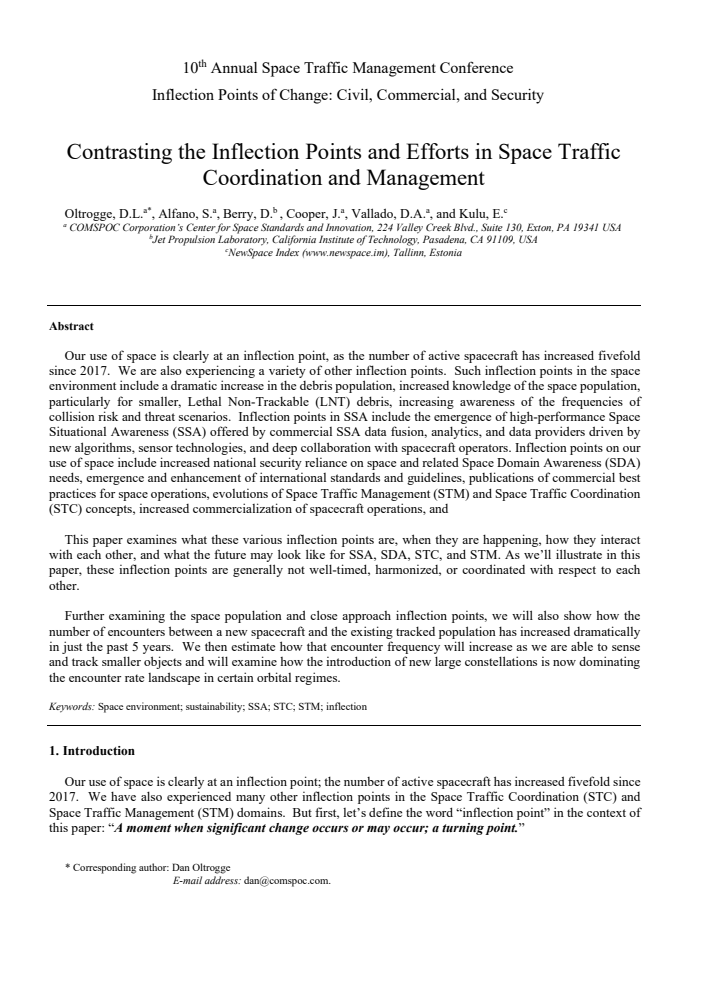
Contrasting the Inflection Points and Efforts in Space Traffic Coordination and Management