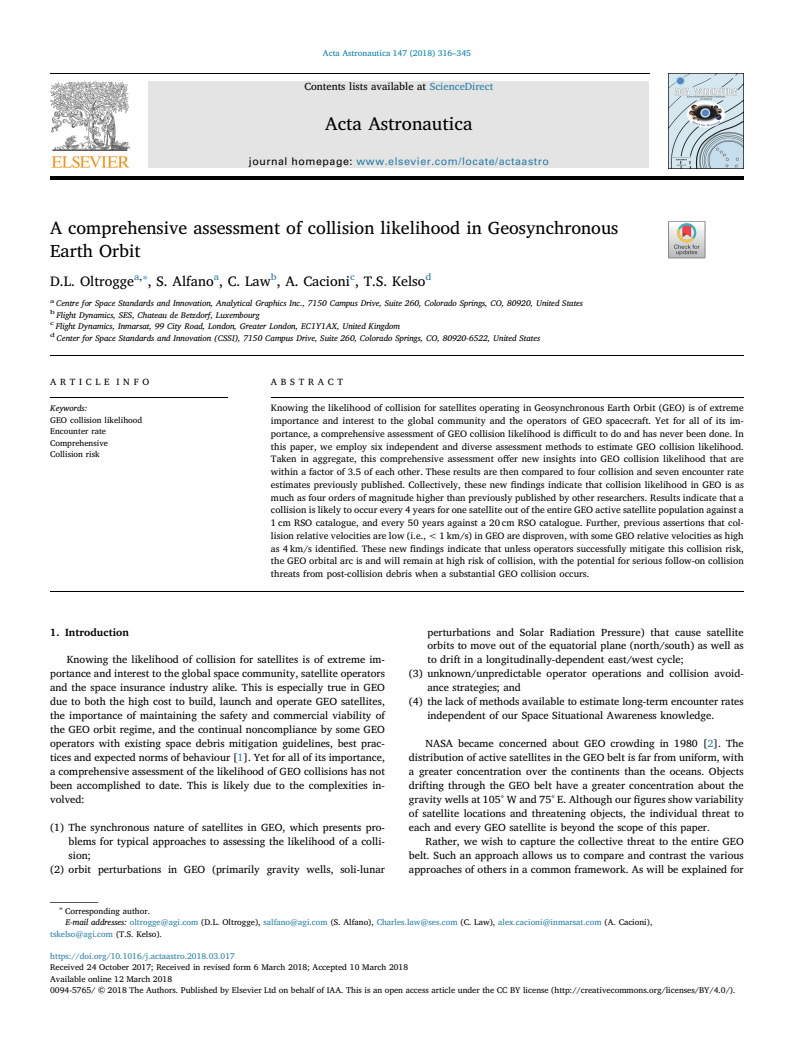
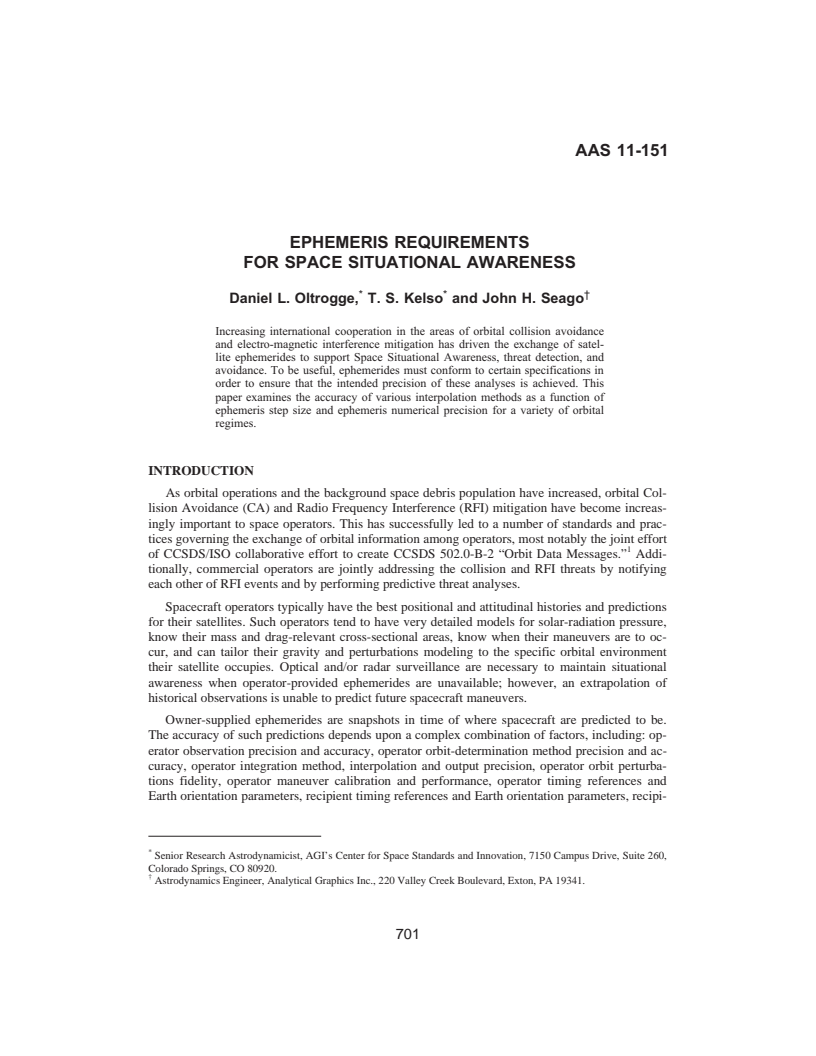
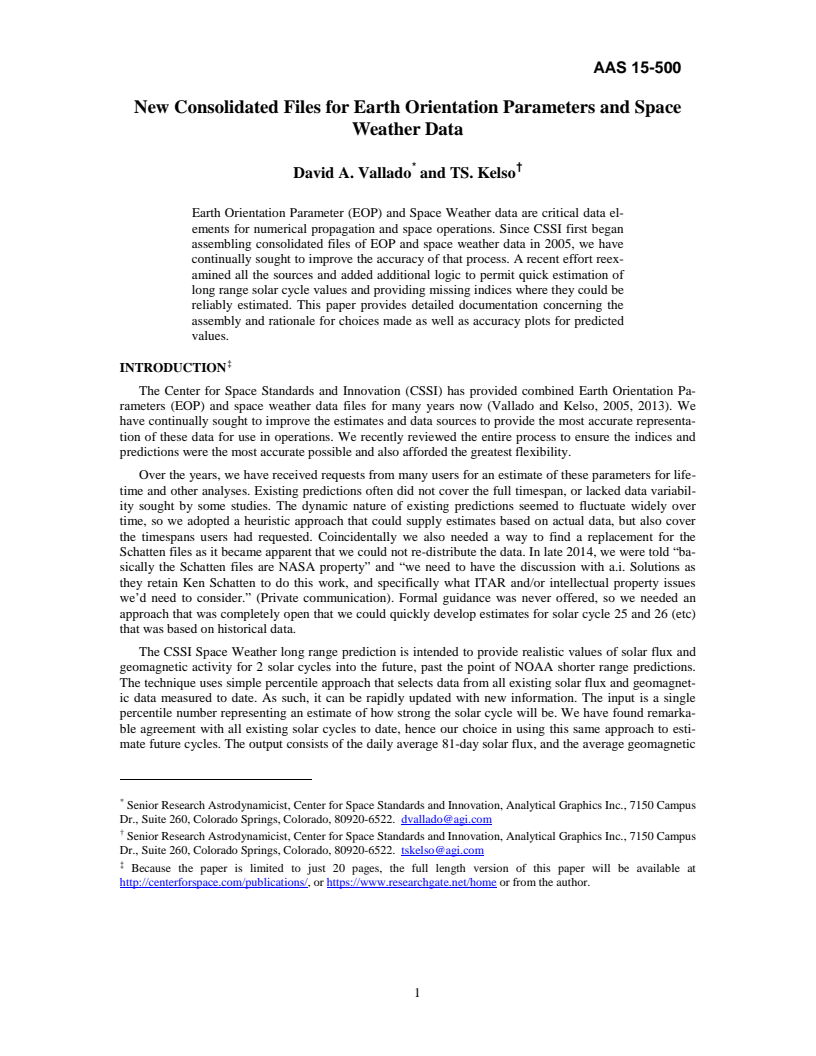
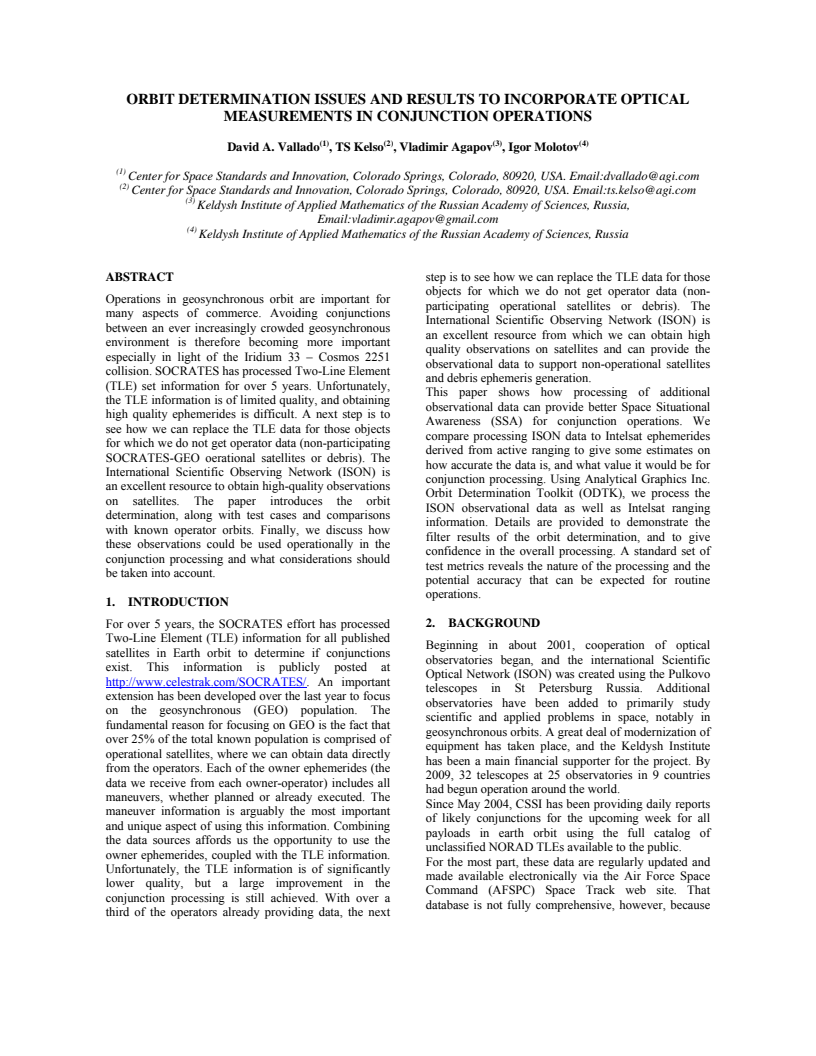
Click an author to filter the list of related assets below.
Abstract:
Our space population continues to increase as satellites are launched and debris-
producing catastrophic events occur. For operators and policy makers, a
periodic examination of the publicly available space population is useful. In
this paper, bivariate distributions and visualizations of orbital elements and
simple spatial density metrics clearly delineate regions of higher collision risk.
For the highest risk region, benefits obtained by application of ISO orbital debris
mitigation standards are discussed. Application of concentric spherical
zone “Ring Shells” governed in latitude by object maximum latitude distribution
helps provide a more realistic spatial density and collision probability picture
compared with previous analyses.
Keywords:
Click a keyword to filter the list of related assets below.
Citation:
Oltrogge, D.L. and Kelso, T.S., “Getting to Know Our Space Population from The Public Catalog,” Paper AAS 11-416, AAS/AIAA Astrodynamics Specialist Conference, Girdwood AK, 1 August 2011, accessible at https://comspoc.com/Resources/Content/Private/C-20220423T144538/Paper/20110803_AAS%2011-413_FINAL_FINAL.pdf.
Papers with related authors:
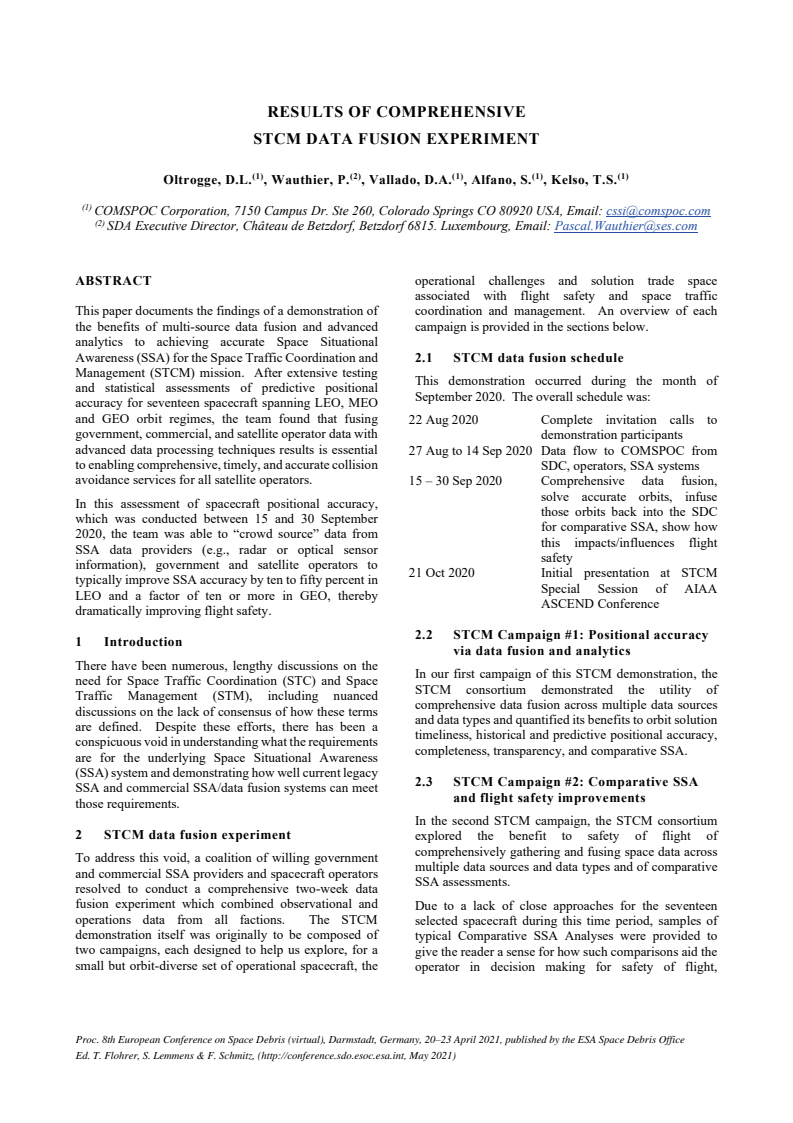
Results of comprehensive STCM data fusion experiment