Abstract:
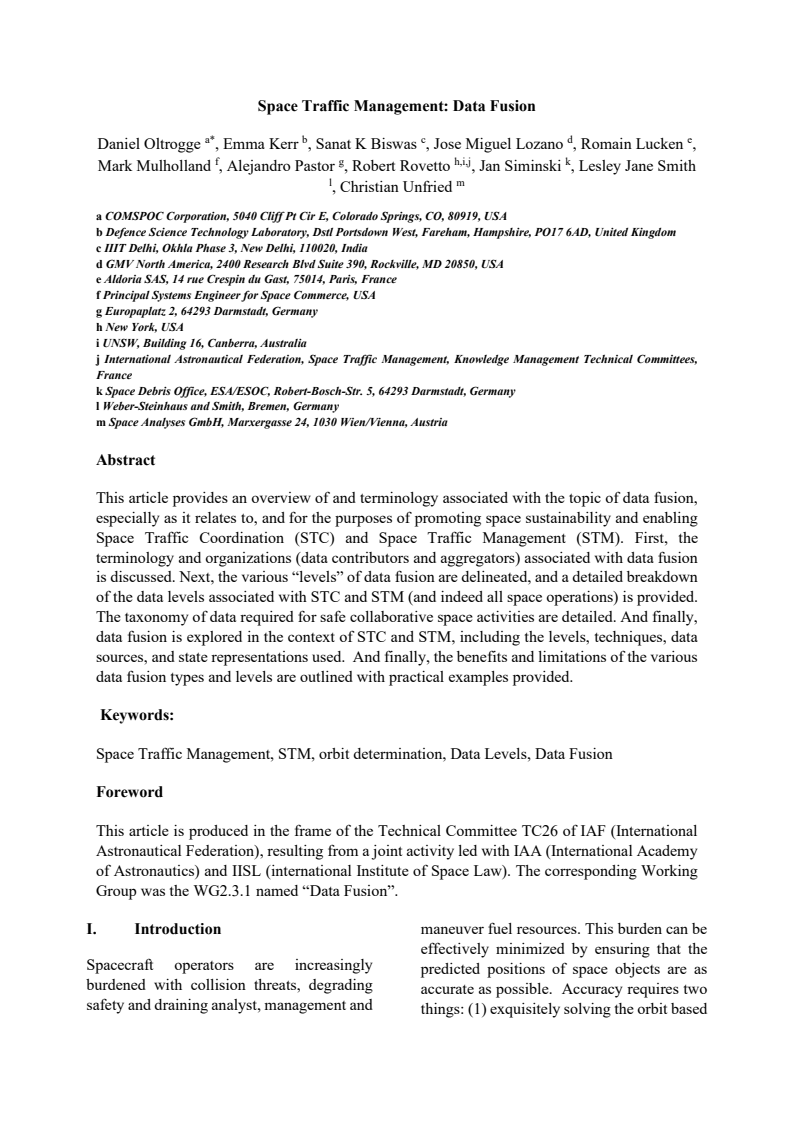
This work examines Space Traffic Management (STM) as a foundational enabler of sustainable outer space activities amid accelerating congestion, debris growth, and operational complexity. It traces the historical drivers of today’s risk environment, including frequent fragmentation events, antisatellite (ASAT) tests, and the rapid deployment of large commercial constellations, which have contributed to a fivefold increase in close-approach rates over the past five years. The analysis highlights critical limitations of current public space catalogs, including incomplete debris representation, limited error characterization, and delayed maneuver recovery, which collectively degrade collision risk assessment and operational decision-making. Using case studies such as the Iridium–Cosmos collision and results from the U.S. Department of Commerce GEO/MEO Pilot, the work demonstrates how unmodeled or mismodeled maneuvers remain a dominant driver of SSA inaccuracy. It shows that deep collaboration between spacecraft operators and commercial SSA providers, combined with multi-sensor data fusion, can yield order-of-magnitude improvements in orbit accuracy and prediction quality. The presentation maps existing and proposed CCSDS data exchange standards to STM functional needs, emphasizing standards as a key bridge between governance aspirations and operational implementation. It concludes that sustaining outer space activities requires accurate, timely, and collaborative SSA architectures underpinned by robust data fusion, maneuver transparency, and internationally harmonized standards.
Keywords:
Click a keyword to filter the list of related assets below.
Oltrogge, D.L., “Examining Space Traffic Management through the lens of sustaining outer space activities,” UNOOSA/Portuguese Space Agency “MANAGEMENT AND SUSTAINABILITY OF OUTER SPACE ACTIVITIES CONFERENCE, Portugal/Virtual, 27-29 Nov 2023.