You must be signed in to view this content. You may need to provide more information to get access to our library.
Id: 398
Type: Conference paper
Published: 08/05/2003
Event: AAS/AIAA Space Flight Mechanics Meeting 2003
Authors:
Click an author to filter the list of related assets below.
Abstract:
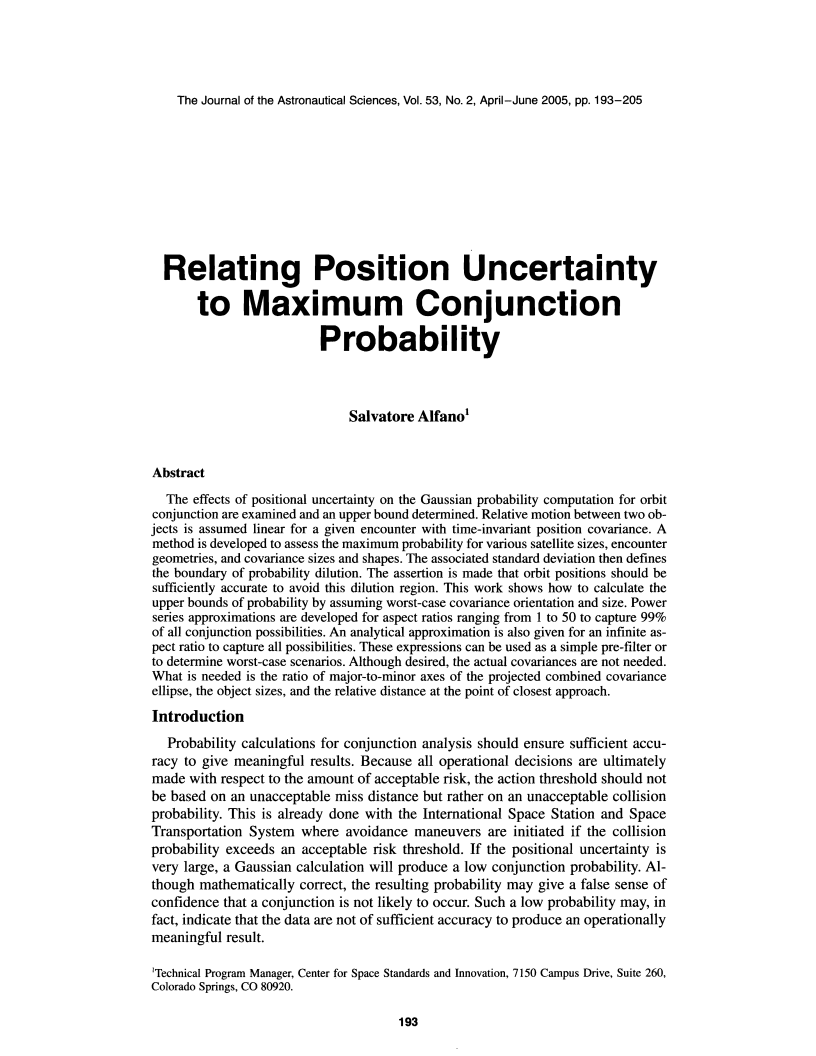
The effects of positional uncertainty on the Gaussian probability computation for orbit conjunction are examined and an upper bound determined. Relative motion between two objects is assumed linear for a given encounter with time-invariant position covariance. A method is developed to assess the maximum probability for various satellite sizes, encounter geometries, and covariance sizes and shapes. The associated standard deviation then defines the boundary of probability dilution. The assertion is made that orbit positions should be sufficiently accurate to avoid this dilution region. This work shows how to calculate the upper bounds of probability by assuming worst-case covariance orientation and size. Power series approximations are developed for aspect ratios ranging from 1 to 50 to capture 99% of all conjunction possibilities. An analytical approximation is also given for an infinite aspect ratio to capture all possibilities. These expressions can be used as a simple pre-filter or to determine worst-case scenarios. Although desired, the actual covariances are not needed. What is needed is the ratio of major-to-minor axes of the projected combined covariance ellipse, the object sizes, and the relative distance at the point of closest approach.
Citation:
Alfano, S., "Relating Position Uncertainty to Maximum Conjunction Probability”, AAS Journal of the Astronautical Sciences, Vol. 53, No. 2, April-June 2005, pp. 193-205.
Papers with related authors:
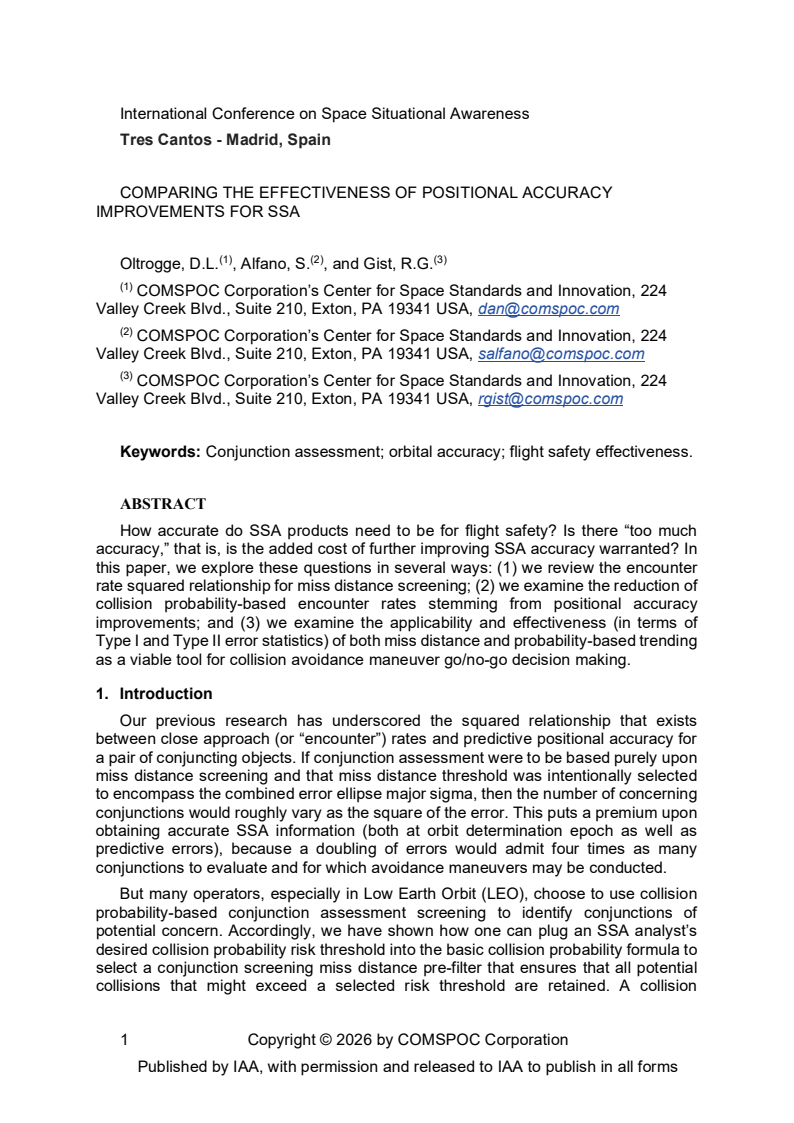
Comparing the effectiveness of positional accuracy improvements