You must be signed in to view this content. You may need to provide more information to get access to our library.
Id: 292
Type: Conference paper
Published: 05/12/2010
Event: AAS Born Symposium 2010
Authors:
Click an author to filter the list of related assets below.
Abstract:
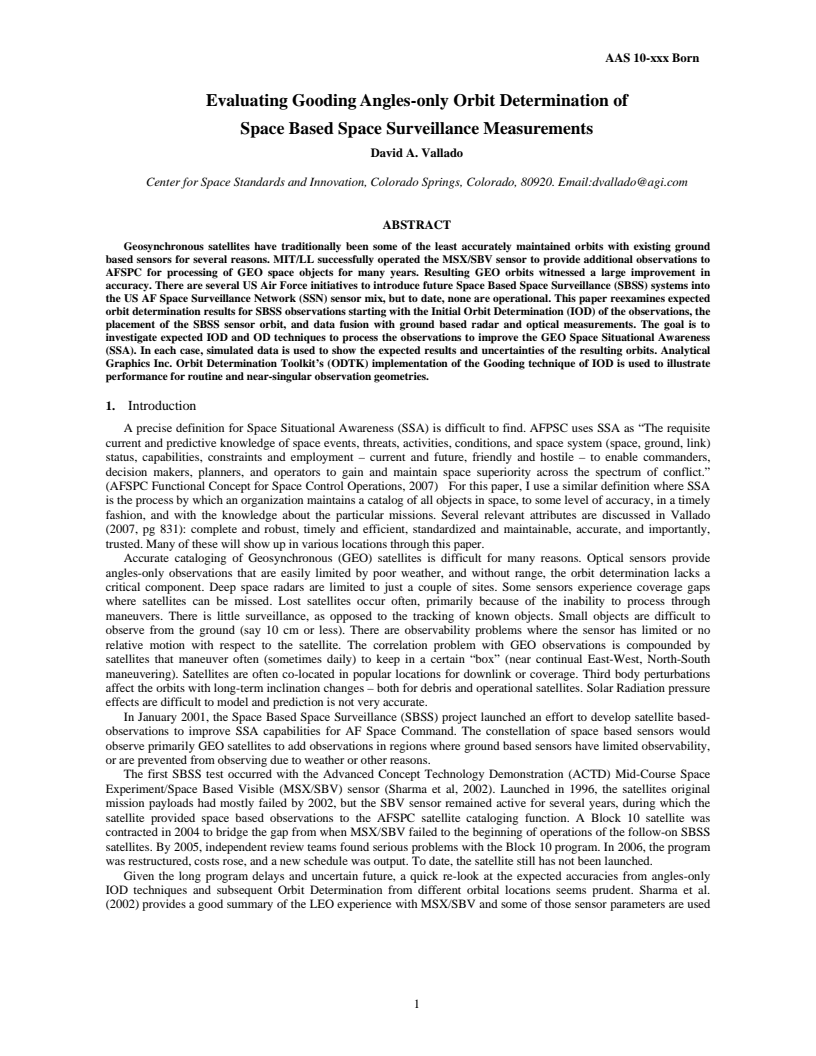
Geosynchronous satellites have traditionally been some of the least accurately maintained orbits with existing ground
based sensors for several reasons. MIT/LL successfully operated the MSX/SBV sensor to provide additional observations to
AFSPC for processing of GEO space objects for many years. Resulting GEO orbits witnessed a large improvement in
accuracy. There are several US Air Force initiatives to introduce future Space Based Space Surveillance (SBSS) systems into
the US AF Space Surveillance Network (SSN) sensor mix, but to date, none are operational. This paper reexamines expected
orbit determination results for SBSS observations starting with the Initial Orbit Determination (IOD) of the observations, the
placement of the SBSS sensor orbit, and data fusion with ground based radar and optical measurements. The goal is to
investigate expected IOD and OD techniques to process the observations to improve the GEO Space Situational Awareness
(SSA). In each case, simulated data is used to show the expected results and uncertainties of the resulting orbits. Analytical
Graphics Inc. Orbit Determination Toolkit’s (ODTK) implementation of the Gooding technique of IOD is used to illustrate
performance for routine and near-singular observation geometries.
Keywords:
Click a keyword to filter the list of related assets below.
Citation:
Vallado, David A. 2010. Evaluating Gooding Angles-only Orbit Determination of Space Based Space Surveillance measurements. Paper AAS 10-xxx presented at the Born Symposium, May 11-14. Boulder, CO, accessible at https://comspoc.com/Resources/Content/Private/C-20220425T154541/Paper/AAS%2010-xxx%20Born%20SBSS%20and%20Gooding.pdf.
Papers with related authors:
A Critical Assessment of Space Data Message Standards and Their Application to Space Force and Partner Missions