Abstract:
This work examines the role of orbital debris as a central driver shaping Space Domain Awareness (SDA) and Space Situational Awareness (SSA) requirements in the modern space operating environment. Using empirical data, encounter-rate analytics, and historical fragmentation events, the study characterizes how growth in active satellites, debris populations, and large constellations has dramatically increased collision risk and operational burden in both Low Earth Orbit and Geosynchronous Earth Orbit. Volumetric encounter analysis and long-term rate estimation methods are used to illustrate trends in close approaches, collision likelihood, and operator workload, including the emergence of conjunction “squalls.” The analysis highlights the disproportionate impact of lethal non-trackable debris and debris generated by antisatellite tests and on-orbit collisions on sustained risk levels. Requirements for decision-quality SSA and SDA are derived, emphasizing accurate orbit determination, realistic covariance, maneuver detection, and comprehensive data processing chains. The work demonstrates that no single data source is sufficient to manage debris-driven risk and that multi-source data fusion, comparative SSA, and standardized data exchange are essential. The study concludes that effective Space Traffic Coordination and Management, supported by international standards and collaborative governance, is foundational to mitigating debris risk and ensuring long-term sustainability of space operations.
Keywords:
Click a keyword to filter the list of related assets below.
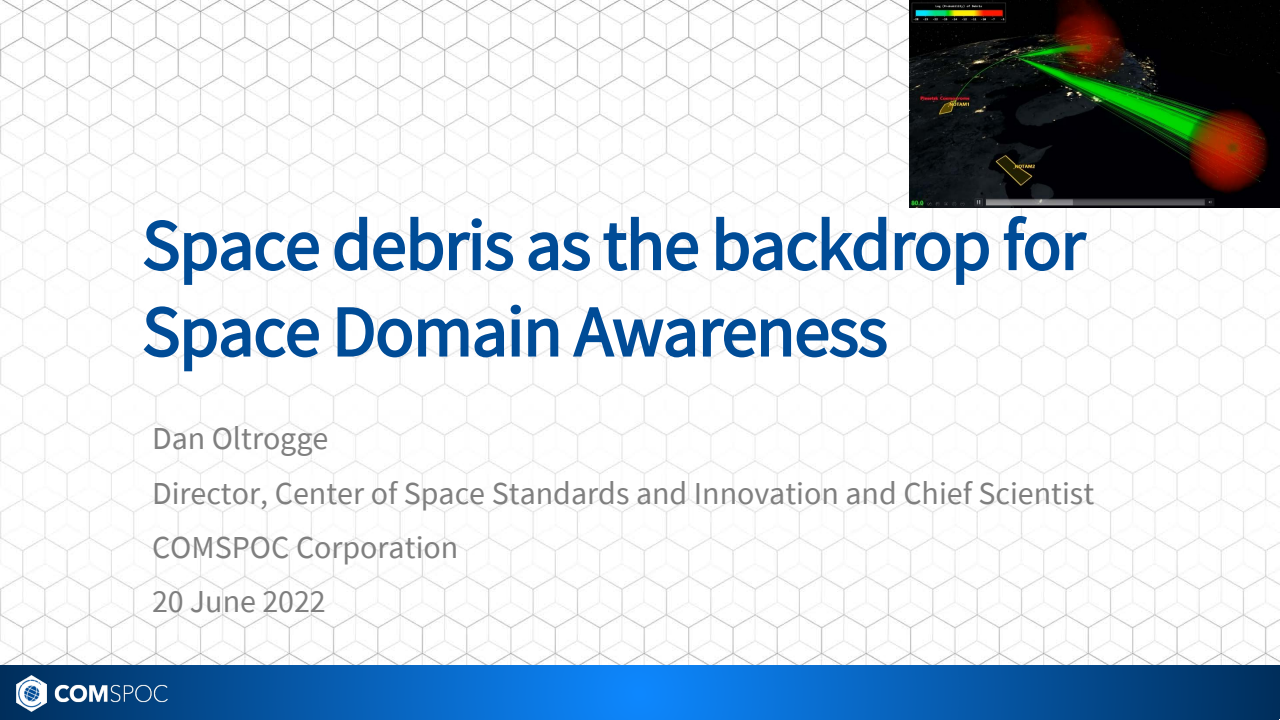
Oltrogge, D.L., “Space debris as a backdrop for Space Domain Awareness,” UCL Space Domain Awareness Colloquim, 20 Jun 2022.