You must be signed in to view this content. You may need to provide more information to get access to our library.
Id: 337
Type: Op-Ed
Published: 04/12/2023
Authors:
Click an author to filter the list of related assets below.
Abstract:
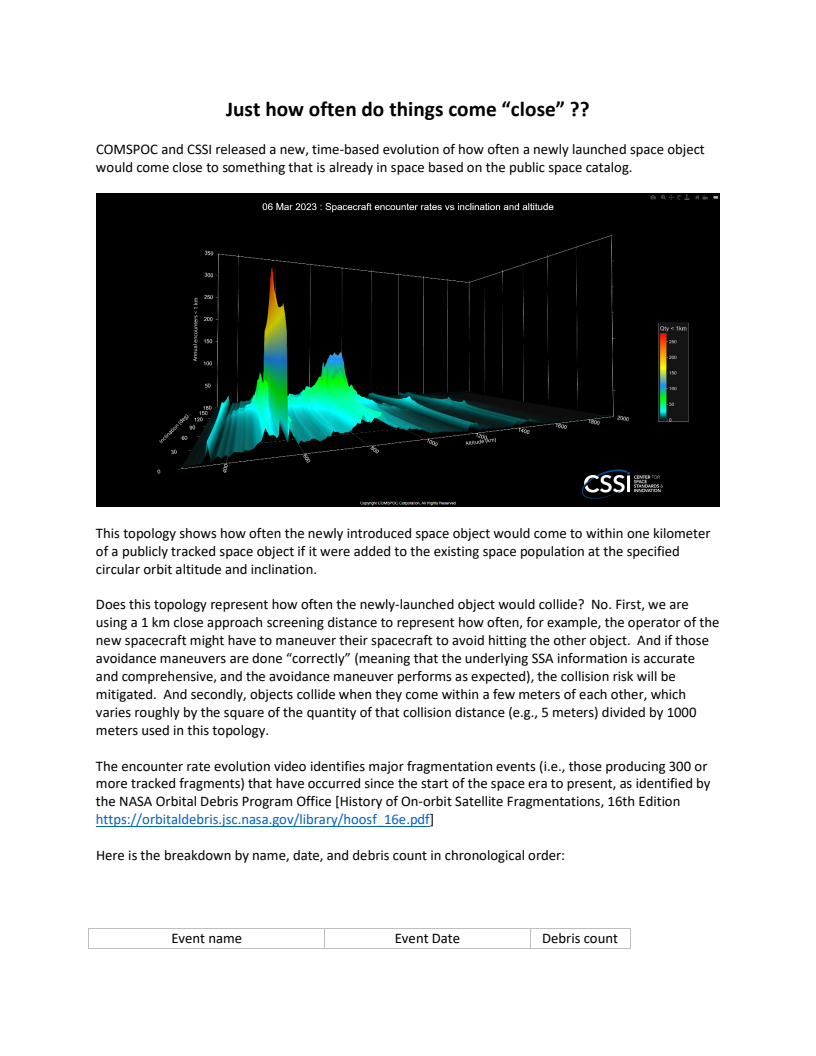
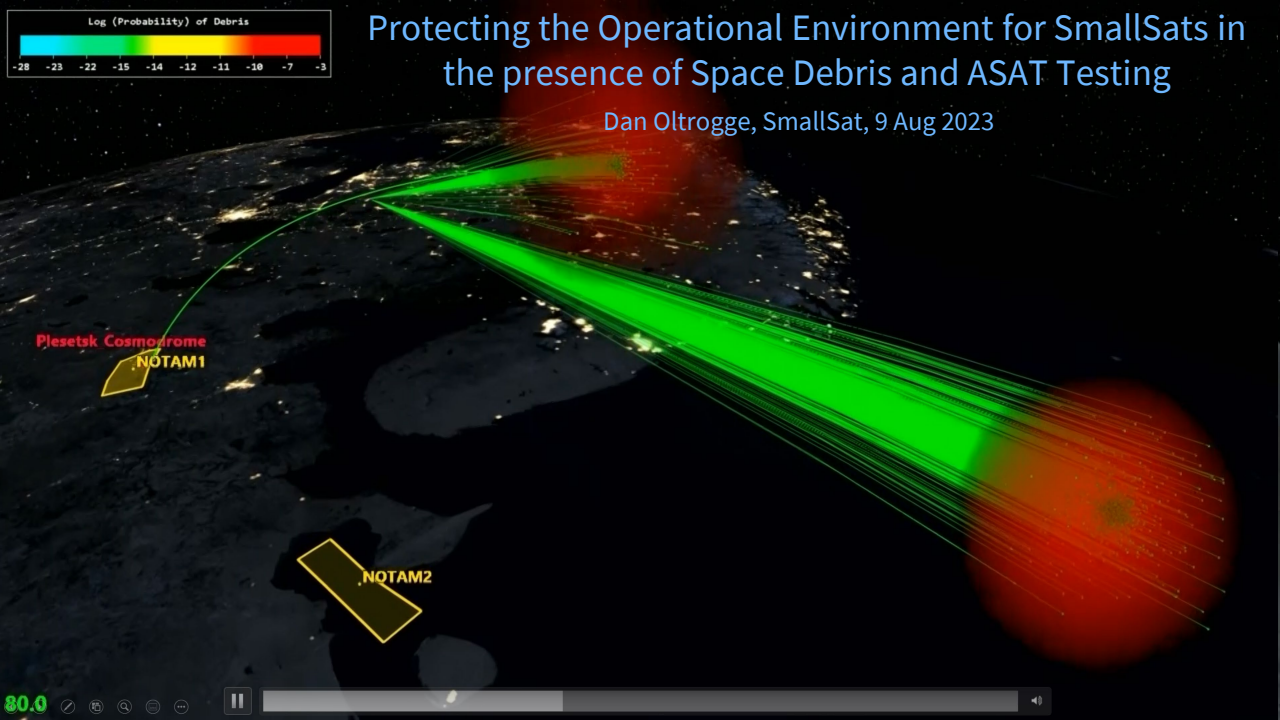
The frequency of close approaches in low Earth orbit can be characterized using a volumetric encounter method that estimates how often a newly introduced spacecraft would pass within one kilometer of existing cataloged objects. This approach assumes random in-track relative positions in mean anomaly space and counts instances where propagated trajectories intersect a specified encounter region, yielding average encounter rates over long timescales. Historical fragmentation events producing large debris populations significantly influence these encounter rates, as shown by analyses of major breakups from 1961 through 2022. Application of the method to the COSMOS 1408 antisatellite event demonstrates how nodal drift and counter-rotating geometries created a pronounced conjunction “squall” for Planet satellites, with volumetric predictions aligning closely with detailed STK/ADVCAT calculations. Additional analyses illustrate how active-on-active, active-on-debris, and active-on-ASAT-debris encounter rates vary by altitude, with COSMOS 1408 fragments adding substantial short-term burden to the LEO environment. These results show that large debris-generating events drive sustained increases in encounter rates, collision probability, and operational workload for satellite operators.
Keywords:
Click a keyword to filter the list of related assets below.
Citation:
Papers with related authors:
A Critical Assessment of Space Data Message Standards and Their Application to Space Force and Partner Missions