Abstract:
Satellite safety in Earth orbit depends heavily on the evolving orbital debris environment across low Earth orbit (LEO) and geosynchronous orbit (GEO). Global radar, optical, and passive sensor systems provide surveillance of resident space objects, though each exhibits limitations in coverage, measurement quality, and orbit determination accuracy. Existing satellite catalogs remain incomplete, with significant fractions of small debris undetected and numerous objects periodically lost, mis-tagged, or classified. Historical breakup and collision events, including antisatellite tests and natural collisions, demonstrate how debris generation, launch activity, and mitigation practices collectively influence catalog growth and long-term collision risk. Ephemeris precision analyses show that space-weather-driven drag variability, orbital eccentricity, and spacecraft maneuvers contribute to degraded conjunction prediction performance, particularly below 700 km and within GEO. Probabilistic conjunction assessment methods and related visualizations further characterize how uncertainties propagate into collision risk evaluation. Overall, satellite risk is shaped by orbit class, catalog fidelity, sensor performance, and the degree to which global debris mitigation and remediation measures are effectively implemented.
Keywords:
Click a keyword to filter the list of related assets below.
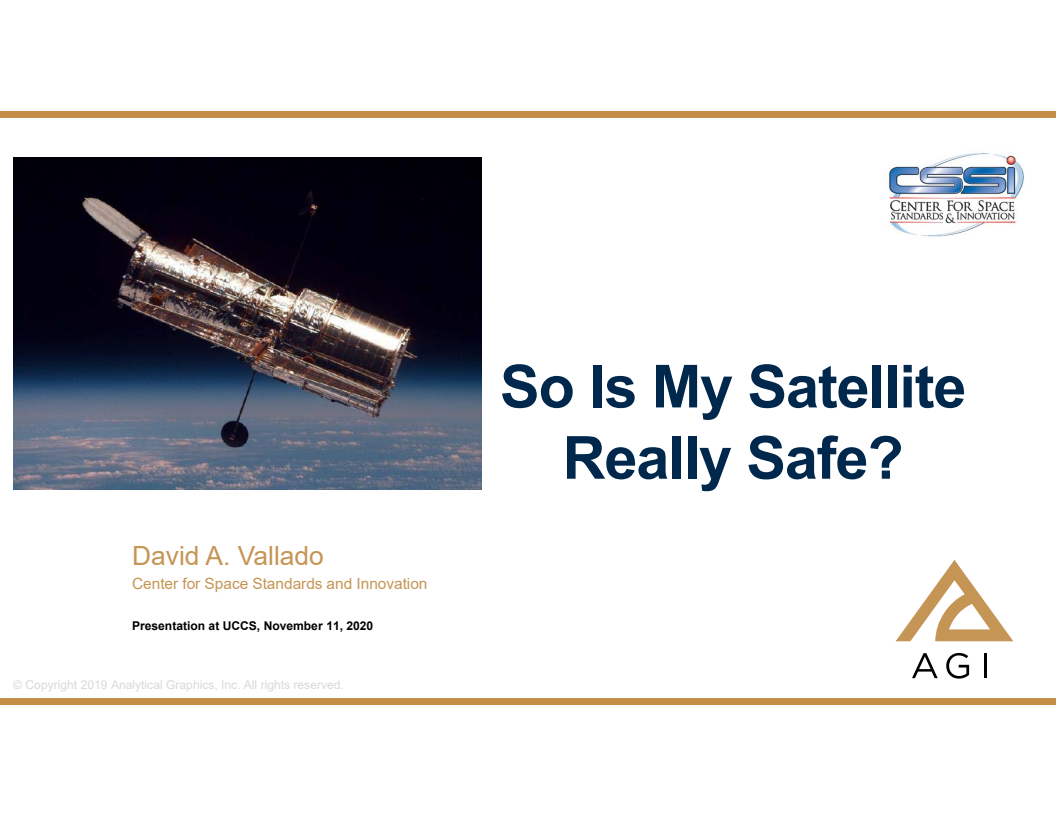
Vallado, D.A., "So is my satellite really safe?," UCCS Guest Lecture, 11 Nov 2020, accessible at https://comspoc.com/Resources/Content/Private/C-20220425T204254/Presentation/UCCS%202020%20Orbital%20Debris%20and%20ConjunctionW.show.pdf.