Abstract:
This work examines the growing operational risks associated with the rapid increase in the space object population and the corresponding need for effective Space Traffic Management (STM). It presents a systems-level framework linking spacecraft design, launch operations, on-orbit operations, and regulatory oversight with Space Situational Awareness (SSA) and Space Traffic Coordination (STC). Using empirical data and visualizations, the study highlights trends such as rising conjunction rates, collision fragments, antisatellite test debris, and the increasing operational burden on satellite operators. The paper emphasizes the importance of impact-to-operator metrics, including encounter rates, conjunction “squalls,” and spatial density evolution over time. International standards developed by ISO and CCSDS are reviewed as critical enablers for interoperability, data exchange, and coordinated safety-of-flight assessments. A cooperative STM architecture is proposed that integrates comparative SSA, multi-source data fusion, normalization, and quality control rather than relying on a single authoritative catalog. The study concludes that sustainable space operations require coordinated governance, standardized data practices, and continuous performance evaluation across safety, security, and long-term sustainability domains.
Keywords:
Click a keyword to filter the list of related assets below.
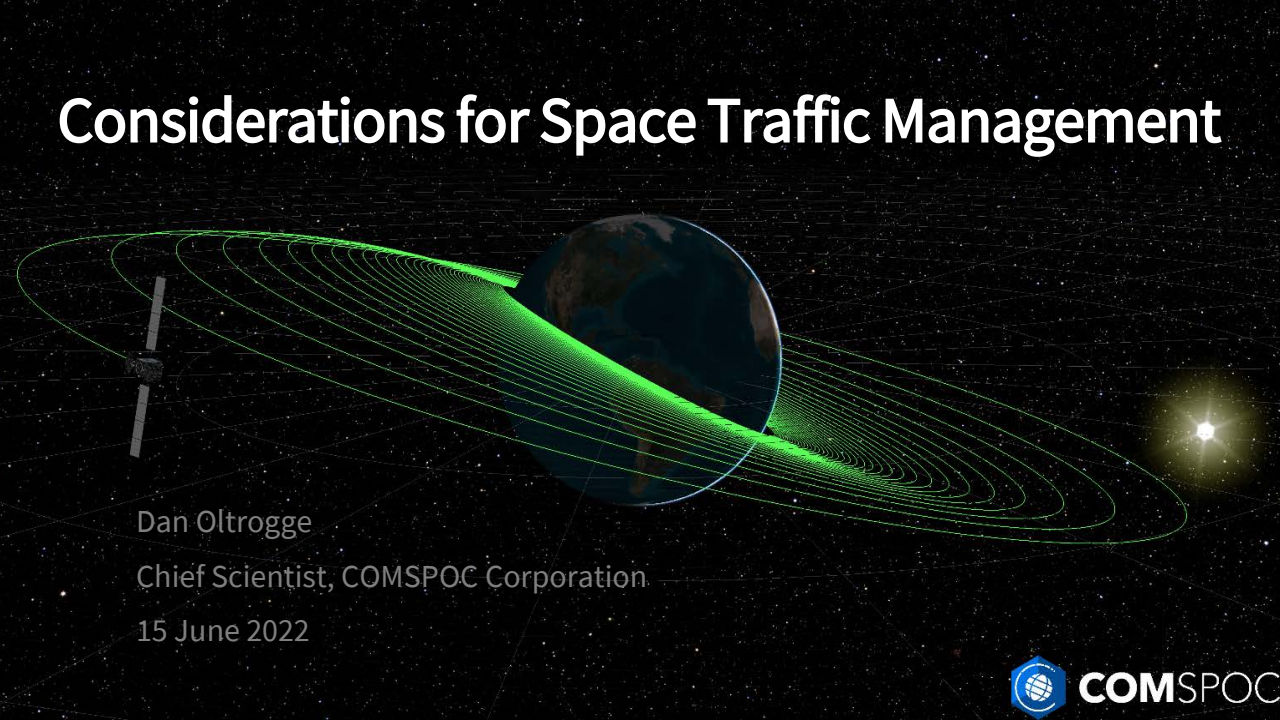
Oltrogge, D.L., “Considerations for Space Traffic Management,” EPP ITRE Meeting “Can Europe Take the Lead in Space?”, 15 June 2022.