Abstract:
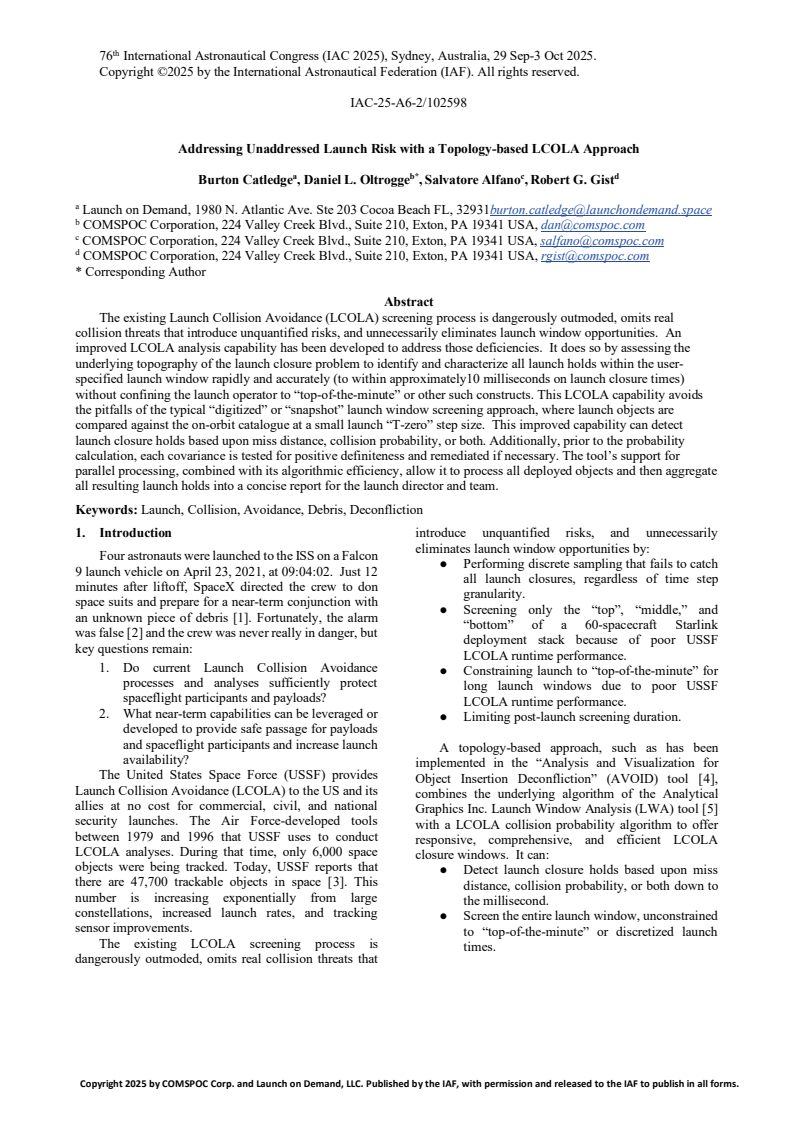
This work develops and evaluates a proposed concept of operations for the deployment of the QB50 CubeSat constellation using the Cyclone-4 launch vehicle. The study formulates a multi-objective optimization framework to maximize post-deployment miss distance and inter-satellite separation rates while minimizing collision probability, operational interference with other missions, and disparities in satellite orbit lifetimes. High-fidelity relative motion analyses are conducted using numerical propagation that includes drag, solar radiation pressure, thrust, and higher-order geopotential effects, with extensive parametric evaluation of deployment thrust direction and timing. Multiple collision and operational risk metrics are introduced to quantify the probability of collision, the probability of operational impingement, and the likelihood of avoidance maneuvers by other operators, with particular emphasis on impacts to the International Space Station. Results indicate that an in-plane, along-velocity thrusting deployment strategy provides the best balance among separation, predictability, and safety objectives. The optimized deployment scheme maintains all QB50 satellites below ISS altitudes during deployment and significantly reduces collision and operational risk. The analysis demonstrates that constellation deployment design must consider not only collision probability but also liability, human spaceflight safety, and broader operational impacts to ensure responsible and sustainable space operations.
Keywords:
Click a keyword to filter the list of related assets below.
Oltrogge, D.L., “QB50 Proposed Deployment ConOps,”, Cal Poly CubeSat Workshop, 25 April 2014, accessible at https://comspoc.com/Resources/Content/Private/C-20220424T072726/Presentation/DLO_64_20140425_DLO_QB50_Proposed_Deployment_ConOps_v12.pdf.