You must be signed in to view this content. You may need to provide more information to get access to our library.
Id: 327
Type: Panel
Published: 08/24/2022
Event: After the KE-ASAT Moratorium: What Next?
Authors:
Click an author to filter the list of related assets below.
Abstract:
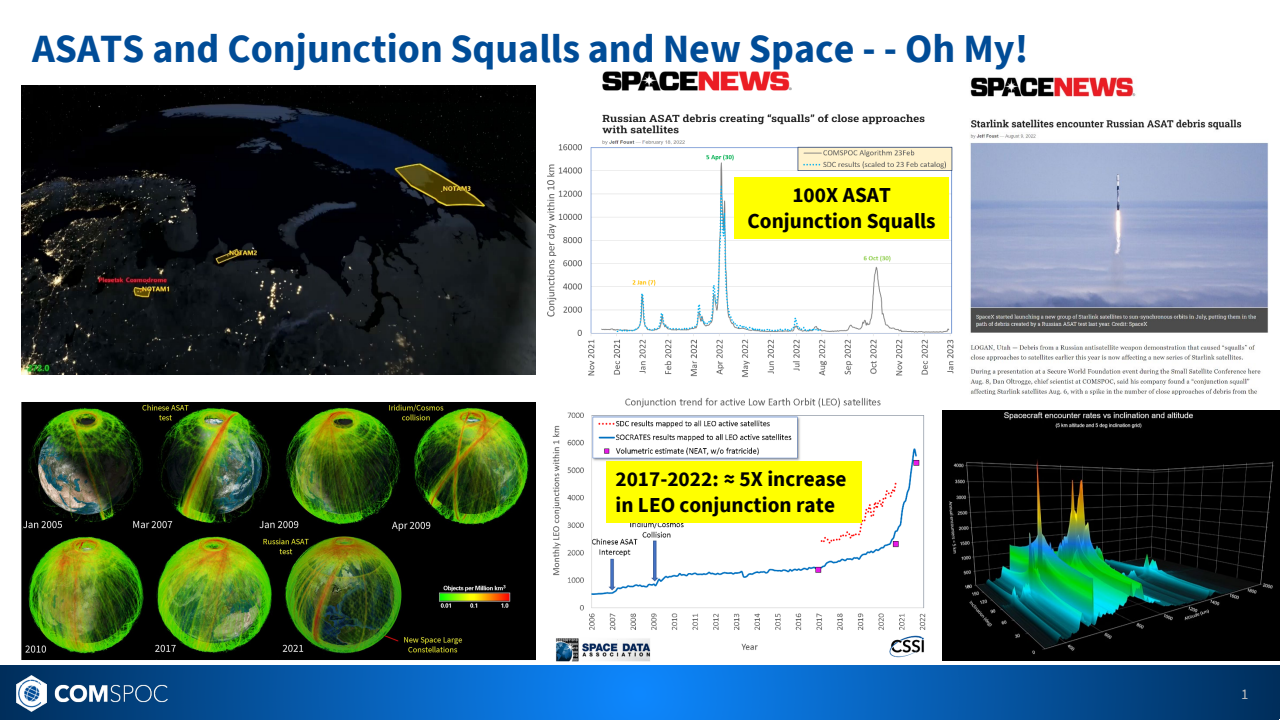
This work examines the rapid escalation of collision risk in low Earth orbit (LEO) driven by antisatellite (ASAT) tests, debris-generating events, and the growth of large commercial constellations. It highlights a roughly fivefold increase in LEO conjunction rates between 2017 and 2022, with ASAT debris events producing “conjunction squalls” that can amplify close-approach rates by orders of magnitude. Using recent debris clouds and operational data, the presentation illustrates how ASAT fragments propagate through orbital regimes, stressing both active satellites and Space Situational Awareness (SSA) systems. The analysis underscores the compounding effects of New Space deployments, where dense satellite populations increase vulnerability to cascading conjunction events. The work argues that current SSA and traffic management frameworks are increasingly strained by these dynamics. Finally, it emphasizes the need for a bottom-up expansion of norms—beginning with commercial best practices and education, and progressing toward standards, guidelines, regulations, and treaties—to mitigate systemic risk and sustain the long-term usability of the LEO environment.
Keywords:
Click a keyword to filter the list of related assets below.
Citation:
Oltrogge, D.L., “ASATS and Conjunction Squalls and New Space - - Oh My!,” George Washington University KE ASAT Moratorium: What next? Workshop, 27 Aug
Papers with related authors:
A Critical Assessment of Space Data Message Standards and Their Application to Space Force and Partner Missions