Abstract:
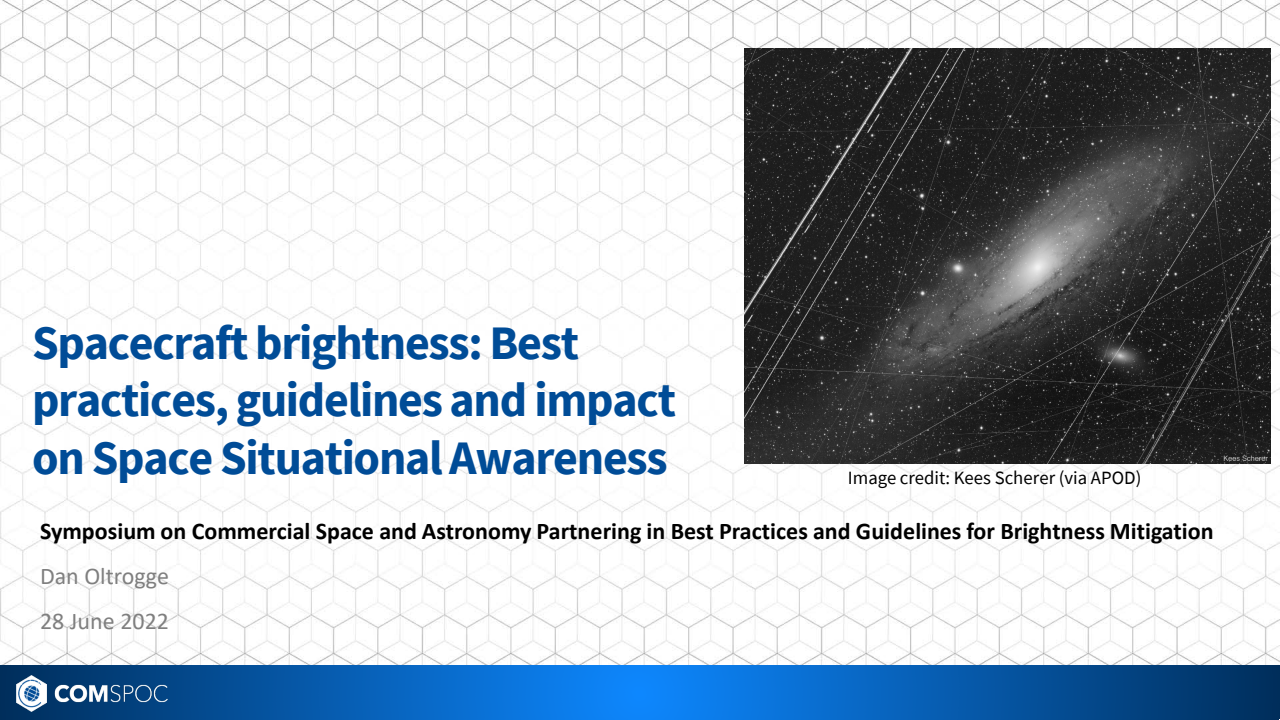
This work examines the growing impact of spacecraft brightness from large low Earth orbit (LEO) constellations on Space Situational Awareness (SSA), astronomical observations, and optical space surveillance. It analyzes how satellite brightness is driven by orbital geometry, altitude, spacecraft design, and illumination conditions, with particular emphasis on twilight and terminator scenarios. Using Starlink as a representative case, the study outlines rudimentary brightness modeling approaches and demonstrates how bright satellites contaminate optical imagery through pixel streaking and wide-field interference. The paper discusses the trade-offs between brightness requirements for non-cooperative SSA tracking and the adverse effects on astronomy and other SSA systems. Existing mitigation strategies are evaluated, including surface darkening, attitude control, orbital selection, and data sharing to support optical masking. Finally, the work reviews the current landscape of international guidelines and standards, highlighting gaps in brightness regulation and emphasizing the need for coordinated best practices, transparency, and standardized data exchange to balance commercial, scientific, and security interests in an increasingly congested LEO environment.
Keywords:
Click a keyword to filter the list of related assets below.
Oltrogge, D.L., “Spacecraft brightness: Best practices, guidelines and impact on Space Situational Awareness”, Symposium on Commercial Space and Astronomy Partnering in Best Practices and Guidelines for Brightness Mitigation, 28 Jun 2022.