Click an author to filter the list of related assets below.
Abstract:
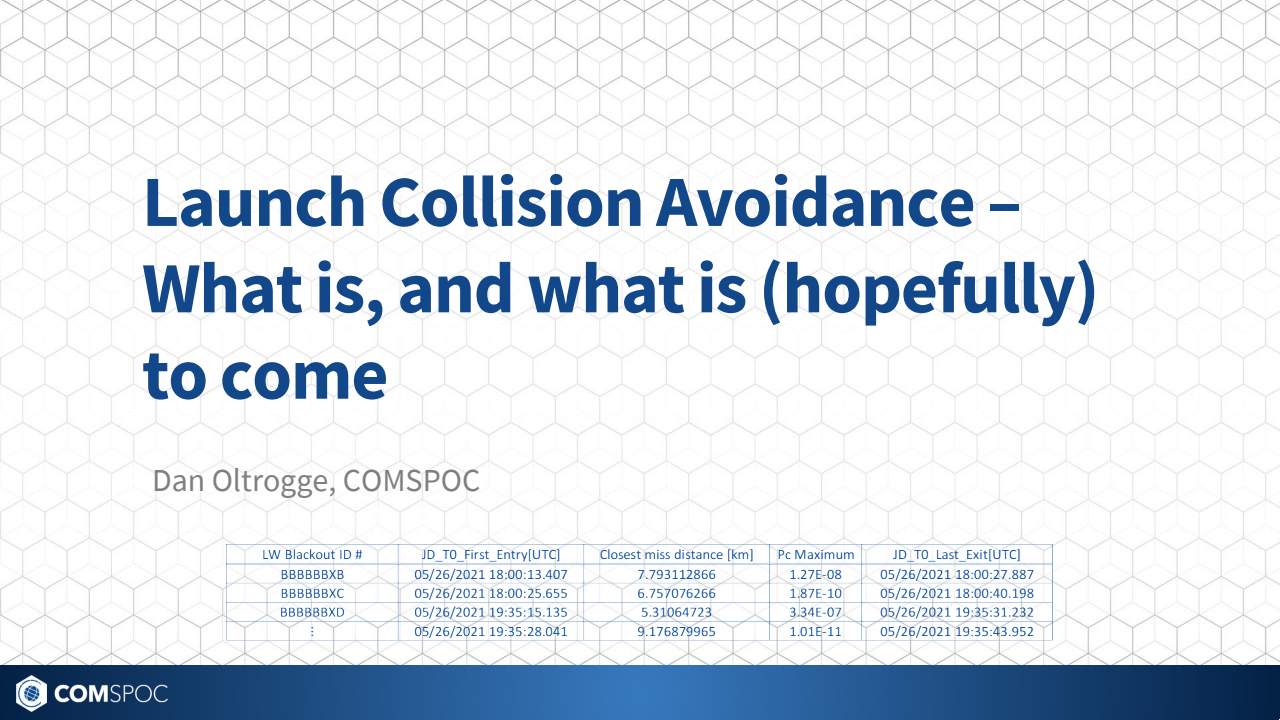
This work examines the current state of Launch Collision Avoidance (LCOLA) practices and argues that existing approaches are increasingly inadequate for a rapidly densifying orbital environment. It documents ongoing international efforts to formalize LCOLA through emerging ISO and CCSDS standards, including proposed minimum screening thresholds for collision probability and miss distance, and highlights wide variation in national practices for both safety and mission assurance LCOLA. The analysis distinguishes between discretized launch-time sampling and topology-based screening approaches, demonstrating that coarse time-step methods can fail to detect valid launch closures and may introduce unquantified risk. Case studies and demonstrations, including commercial validation exercises and SpaceX Transporter-2 analyses, are used to show that advanced commercial tools can achieve high-fidelity agreement with government assessments while providing greater computational efficiency and completeness. The work further discusses data limitations, especially the scarcity of authoritative covariances, and identifies synthetic covariance generation as a practical enabler for operational LCOLA. It concludes that without modernization of tools, broader data sharing, and adoption of robust standards, launch opportunities will continue to erode and systemic safety risks will increase.
Keywords:
Click a keyword to filter the list of related assets below.
Citation:
Oltrogge, D.L., “Launch Collision Avoidance – What is, and what is (hopefully) to come,” Mitre Launch Optimization Technical Exchange Meeting, Washington, D.C., 27 Aug 2024.
Papers with related authors:
A Critical Assessment of Space Data Message Standards and Their Application to Space Force and Partner Missions