Abstract:
This work examines how the rapid growth of space activities in the New Space era has fundamentally altered the operational risk landscape in Earth orbit. Drawing on empirical data from satellite licensing applications, launch statistics, and conjunction analyses, the study characterizes dramatic increases in active spacecraft populations, close-approach rates, and collision risk, particularly in Low Earth Orbit. Volumetric encounter-rate methods and comparative assessments of major fragmentation events are used to illustrate how large constellations, antisatellite debris, and lethal non-trackable fragments drive sustained operational burden on satellite operators. The analysis highlights the emergence of recurrent conjunction “squalls,” which significantly amplify warning volumes and maneuver demands. A layered framework is presented linking Space Situational Awareness, Space Traffic Coordination, and Space Traffic Management with international standards, national regulation, and commercial best practices. The role of data sharing, normalization, and multi-source data fusion is emphasized as essential for decision-quality flight safety. The study concludes that maintaining safe and efficient use of space requires a collaborative governance approach, widespread adoption of international standards, and proactive coordination among operators, regulators, and SSA providers to ensure long-term orbital sustainability.
Keywords:
Click a keyword to filter the list of related assets below.
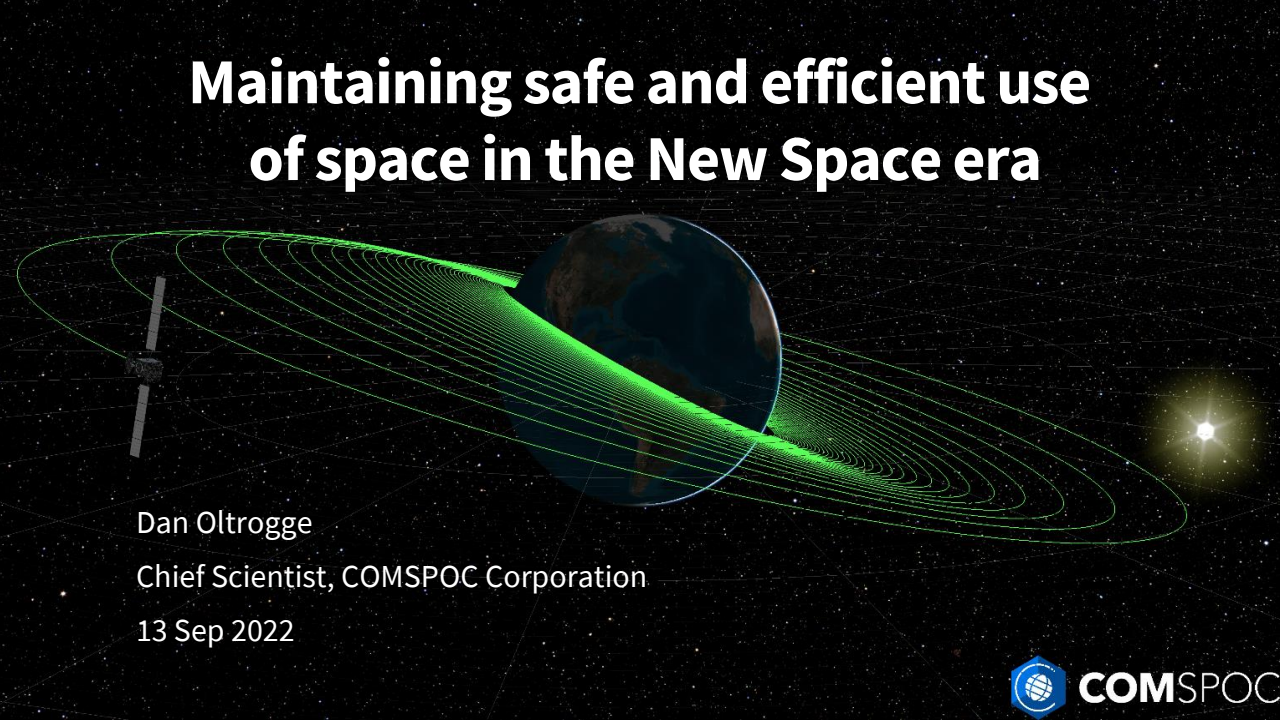
Oltrogge, D.L., “Maintaining safe and efficient use of space in the New Space era,” International Space Radio Monitoring Meeting, Paris France, 13 Sep 2022.