You must be signed in to view this content. You may need to provide more information to get access to our library.
Id: 353
Type: Presentation
Published: 08/09/2023
Event: Small Satellite
Authors:
Click an author to filter the list of related assets below.
Abstract:
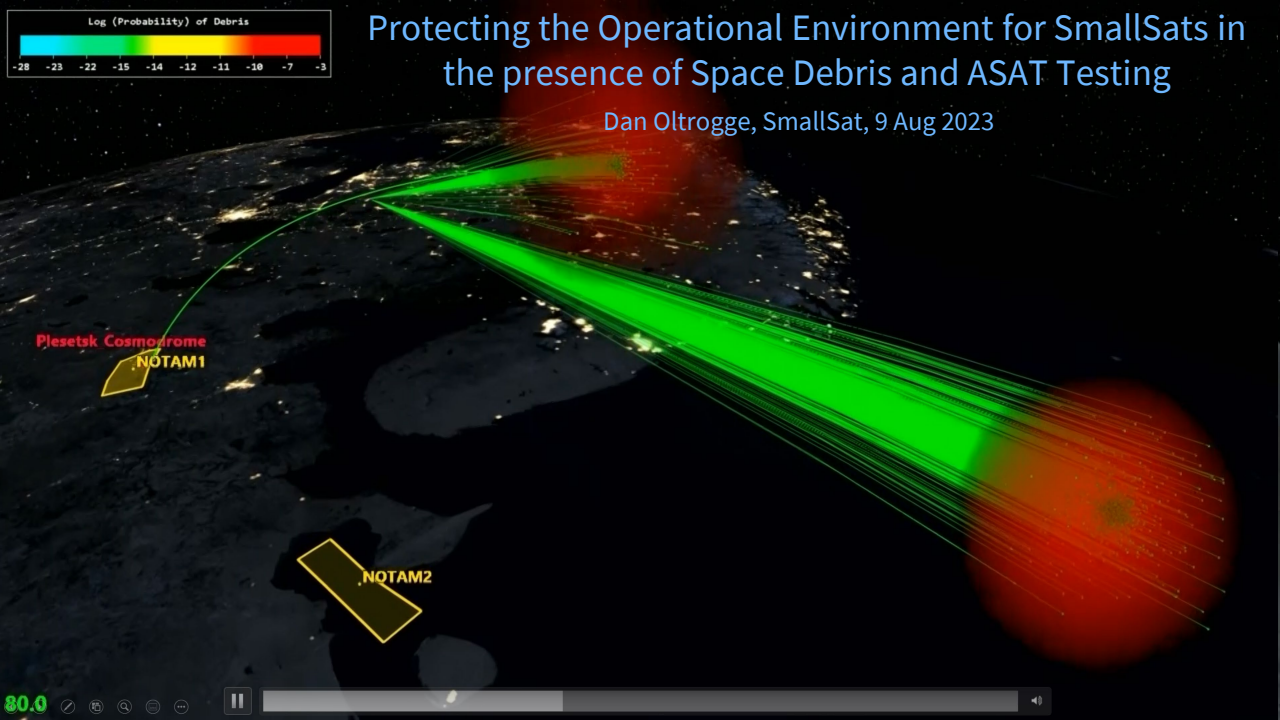
This work analyzes the impacts of space debris and antisatellite (ASAT) testing on the operational safety of small satellites, with particular emphasis on CubeSat and Earth-observing constellations in low Earth orbit. Using conjunction statistics, risk modeling, and debris propagation analyses, the study shows that recent ASAT fragmentation events have dramatically increased close-approach rates, producing sustained “conjunction squalls” that overwhelm flight safety systems. Results demonstrate that CubeSats experience the largest increase in warning volume due to their orbital regimes, while larger spacecraft face the greatest absolute collision risk because of their physical cross-section. The analysis highlights elevated risk during the first 24 hours after debris-generating events, especially for coplanar and near-antiparallel orbital geometries. Case studies illustrate how sun-synchronous Earth-observation missions and the International Space Station have been disproportionately affected by ASAT debris clouds. The work quantifies increased operator workload and degraded safety margins across multiple altitude bands. It concludes that ASAT testing has severe and long-lasting consequences for the space operating environment and underscores the need for stronger norms, data sharing, and coordinated Space Situational Awareness to protect small satellite operations and sustain the long-term usability of Earth orbit.
Keywords:
Click a keyword to filter the list of related assets below.
Citation:
Oltrogge, D.L., “Protecting the Operational Environment for SmallSats in the presence of Space Debris and ASAT Testing,” 2023 Small Satellite Conference Side-Panel, 9 Aug 2023.
Papers with related authors:
A Critical Assessment of Space Data Message Standards and Their Application to Space Force and Partner Missions