Click an author to filter the list of related assets below.
Abstract:
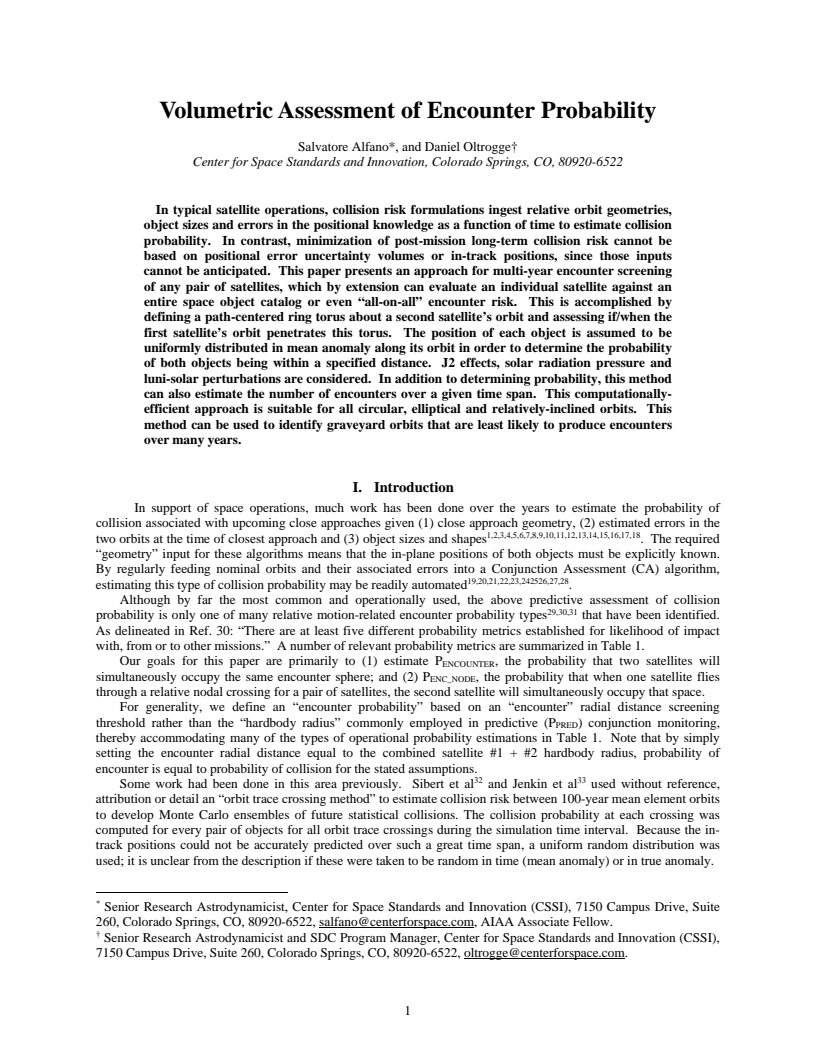
In typical satellite operations, collision risk formulations ingest relative orbit geometries, object sizes and errors in the positional knowledge as a function of time to estimate collision probability. In contrast, minimization of post-mission long-term collision risk cannot be based on positional error uncertainty volumes or in-track positions, since those inputs cannot be anticipated. This paper presents an approach for multi-year encounter screening of any pair of satellites, which by extension can evaluate an individual satellite against an entire space object catalog or even “all-on-all” encounter risk. This is accomplished by defining a path-centered ring torus about a second satellite’s orbit and assessing if/when the first satellite’s orbit penetrates this torus. The position of each object is assumed to be uniformly distributed in mean anomaly along its orbit in order to determine the probability of both objects being within a specified distance. J2 effects, solar radiation pressure and luni-solar perturbations are considered. In addition to determining probability, this method can also estimate the number of encounters over a given time span. This computationally-efficient approach is suitable for all circular, elliptical and relatively-inclined orbits. This method can be used to identify graveyard orbits that are least likely to produce encounters over many years.
Keywords:
Click a keyword to filter the list of related assets below.
Citation:
Alfano, S. and Oltrogge, D.L., “Volumetric Assessment of Encounter Probability,” AIAA/AAS Astrodynamics Specialist Conference, San Diego, CA 8 August 2014, accessible at https://comspoc.com/Resources/Content/Private/C-20220424T074248/Paper/Volumetric%20Assessment%20of%20Satellite%20Encounters%20DOC_v40.pdf.
Papers with related authors:
A Critical Assessment of Space Data Message Standards and Their Application to Space Force and Partner Missions